


A damaged fence post can look like a small cosmetic problem, but movement at one point may involve the footing, adjoining rails, panels, or the ground around the fence. For Anaheim and Orange County properties, the right repair decision starts with understanding what is actually supporting the fence line.
Vinyl fence post replacement is a site-specific project. A contractor should inspect the post, footing, adjoining rails, and surrounding conditions before confirming whether one post, connected sections, or a larger portion of the fence needs attention.
If you are comparing repair and replacement options, photos and details about leaning, impact, movement, or nearby gates can help begin the conversation. A G Vinyl Fencing provides repair, modification, and replacement services for residential and commercial customers, with more than 35 years of local experience.
First, it helps to understand what the replacement process includes and why the visible post is only one part of the assessment.
What Does Vinyl Fence Post Replacement Involve?
Vinyl fence post replacement is a site-specific project, not simply a matter of sliding one new piece into place. The post helps hold the fence line in position, but its condition is connected to the footing, the sections attached to it, and the ground around it. A useful replacement plan starts by identifying what is actually damaged and what must remain stable after the work is complete.
The post and its footing
The visible vinyl post is only one part of the support system. Beneath it, the footing and surrounding soil affect how securely the fence stands. A post that leans, moves, or has been damaged by an impact may have a problem that extends below the visible surface. Water, grade changes, or other site conditions can also affect the footing. That is why the post and footing should be considered together rather than treating the post as an isolated sleeve.
Rails, panels, and caps
Rails connect the fence sections to the posts, while panels fill the space between the rails and define the fence’s appearance and privacy level. A replacement post must work with those connections and with the existing layout. The surrounding rails or panels may need attention if they are cracked, displaced, or no longer align with the proposed post. The post cap is a separate finishing component. It may be reusable, damaged, or a detail that needs to match the replacement work.
For a broader explanation of these components and related materials, see this guide to vinyl fence repair supplies. This article takes a narrower approach by focusing on how those parts affect replacement planning.
Gates require extra attention
A gate post may carry more responsibility than a standard line post because it supports access hardware and repeated movement. The condition of the gate, hinges, latch, and adjacent fence connections can therefore affect the replacement scope. A new post should not be selected without considering how the gate operates and whether the existing hardware remains suitable.
Before recommending a repair or replacement scope, a contractor should inspect the post, footing, adjoining rails, and site conditions. One post may sometimes be addressed as a focused project, but there is no guarantee that adjacent sections will remain completely undisturbed. A G Vinyl Fencing provides design, installation, repair, modification, and replacement services, allowing the project to be evaluated as a connected fence system rather than as a single loose component.
Which Signs Mean a Vinyl Fence Post Needs Replacement?
A damaged post is not always obvious, and a visible problem does not automatically mean the post must be replaced. Treat changes in the fence as reasons to arrange an inspection. The goal is to determine whether the issue is limited to a connection, involves the footing, or affects nearby rails and panels.
Look for leaning or a changing fence line
A post that no longer stands in line with the rest of the fence deserves attention. You may notice a section tilting, a run that appears uneven, or a post that has gradually shifted after heavy weather or an impact. Compare the affected area with adjacent posts from several angles, but do not assume that straightening the visible post will solve the underlying issue. Soil, footing, grade, or connected components may all affect the final repair scope.
Check for movement, separation, or impact damage
Movement is another useful inspection prompt. If a post, rail, panel, or gate connection moves noticeably when handled normally, the assembly may need closer evaluation. Gaps or separation where components meet can also indicate that the fence line has shifted or that a connection needs attention. A vehicle, fallen branch, landscaping equipment, or another impact may leave cracks, distortion, or a visibly displaced section. Document what happened and which parts appear affected before attempting a repair.
Pay attention to water, soil, and functional changes
Persistent standing water, erosion, settled soil, or changes in grade near a post can change the conditions around the fence. These observations do not prove that the footing has failed, but they are important details for an inspection. A gate that no longer aligns, latches, or swings as it once did may also point to movement in a nearby post or supporting connection. Avoid forcing the gate or loading a visibly unstable section while you decide what to do next.
For a practical vinyl fence post replacement assessment, a contractor should inspect the post, footing, adjoining rails, and site conditions before recommending a scope. Some signs may call for a focused repair, while others may justify replacement of one post or a larger connected section. Sharing clear photos, the location of the damage, and any recent impact or drainage changes can help the contractor prepare for a more useful site review.
How Should You Check the Post, Footing, and Fence Line?
A leaning or damaged post is only one part of the fence assembly. Before deciding that vinyl fence post replacement is the right scope, look at the surrounding conditions as a connected system. A careful assessment helps separate visible damage from the condition that may have caused it, while avoiding assumptions that cannot be confirmed from a quick glance.
- Observe the post and base: Note leaning, movement, cracks, separation, height changes, erosion, settlement, or drainage concerns. Do not force the post back into position or remove it just to see what is underneath.
- Follow the connections: Check adjoining rails and panels for separation, stress, movement, or misalignment. Note whether the post supports a corner, end, gate, or change in direction.
- Record site constraints: Identify slopes, retaining walls, paving, planters, utilities, landscaping, gates, and access limits that could affect the work.
- Arrange an inspection: Share photos and the location of the problem, then let a contractor assess the post, footing, fence line, grade, drainage, and access together.
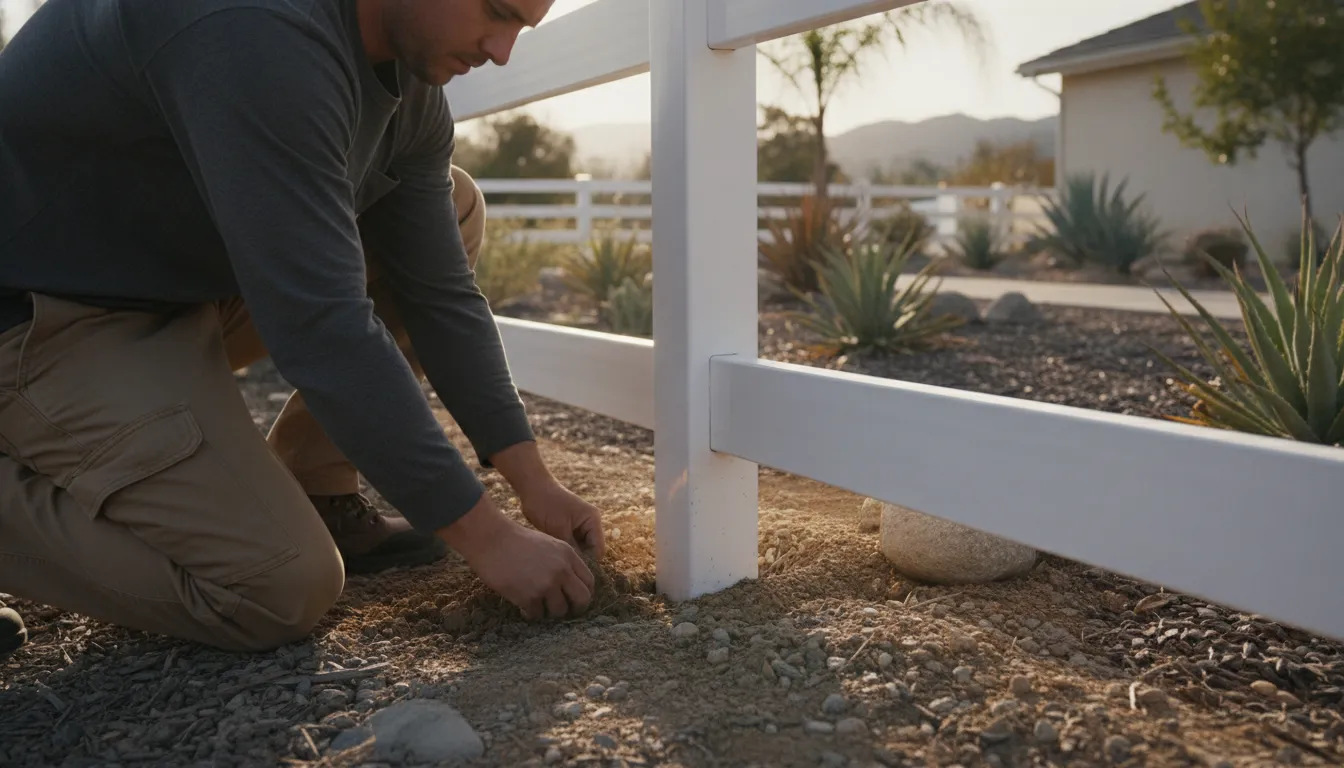
Look for signs that water, erosion, settlement, landscaping work, or an impact may have affected the base. These observations are useful for an inspection, but they are not a structural diagnosis. The visible post may need attention, while the underlying footing or surrounding grade may also be part of the project.
Trace the fence line in both directions. Compare grade, gaps, post heights, and alignment rather than viewing the damaged area in isolation. If the fence is installed on or beside a retaining wall, the wall’s condition, drainage, attachment options, and approvals deserve their own review. See the guide to vinyl fence on retaining walls for that specific situation.
What a professional inspection adds
A contractor can assess the post, footing, adjoining rails, fence line, grade, drainage, and access conditions together before recommending a repair or replacement scope. That review helps identify which components may be reusable, what must be protected during the work, and whether matching or coordination issues affect the plan. The appropriate scope should follow the site inspection rather than a guaranteed DIY sequence or a remote diagnosis.
Can One Vinyl Fence Post Be Replaced Without Rebuilding the Fence?
Sometimes, a damaged post can be addressed as a focused section of work rather than a complete fence rebuild. That outcome depends on how the post connects to the adjoining panels and rails, whether the footing can be removed or repaired, and whether the surrounding fence line remains stable. A visual inspection is necessary before anyone can responsibly define the scope of a vinyl fence post replacement.
Vinyl fence sections are assembled as a system. Removing one post may require loosening or temporarily supporting the rails and panels on either side. If those connections release cleanly and the adjoining components are sound, the work may stay limited to one post and its footing. If a rail is cracked, a panel is damaged, or the connections are distorted, adjacent sections may need to be removed or replaced so the finished fence is secure and aligned.
What can expand the work beyond one post?
- Footing condition: A post that leans or moves may have a failed, damaged, or inadequate footing. Replacing the visible post without addressing the base can leave the same stability problem in place.
- Grade and drainage: Sloped ground, changes in elevation, soil movement, or water-related conditions can affect how the post is set. A retaining wall or unusual attachment also changes the installation approach.
- Gates and access: A post supporting a gate carries different operating demands from a line post. Hinges, latches, clearance, and daily traffic may need attention. Related planning may include vinyl fence gate hardware.
- Matching: An older fence may have a different post profile, color, texture, height, or panel system than current materials. A close match may be possible, but it should be confirmed rather than assumed.
- Access: Tight side yards, landscaping, walls, utilities, or commercial operating areas can affect how materials and tools reach the post. Limited access may make a seemingly small repair more involved.
The existing vinyl fence posts guide provides general information about posts. This replacement decision is narrower. It requires evaluating the specific post, footing, adjoining rails and panels, grade, gate conditions, and access at the property. A professional installation assessment can then distinguish a focused repair from work that should include neighboring sections, without promising a one-post fix before the site is reviewed.
What Affects Vinyl Fence Post Replacement Cost and Timing?
A vinyl fence post replacement estimate depends on the condition of the post and everything connected to it. A post may be damaged while the footing remains sound, or the visible problem may point to movement, deterioration, or instability below grade. The adjoining rails, panels, gates, soil, drainage, access, and need to match existing materials can all change the recommended scope. That is why a reliable estimate follows an inspection rather than a remote guess.
| Project condition | What it can change | What to confirm |
|---|---|---|
| Damage limited to the post | The work may remain focused if connected components and the footing are suitable. | Whether the rails, panels, caps, and footing can be preserved. |
| Damaged or unstable footing | Additional preparation may be needed before a replacement post can be installed securely. | The footing condition, soil support, drainage, and grade. |
| Connected rails, panels, or a gate | Adjacent fence sections may need to be adjusted, supported, or replaced. | How connections affect access, alignment, operation, and appearance. |
| Restricted access or site complications | Moving materials and working safely may require additional coordination. | Gate access, landscaping, structures, utilities, and work space. |
| Material or color matching | Available replacement components may affect the recommended approach. | Existing profile, color, finish, age, and compatible parts. |
The customer context does not establish a fixed price or standard replacement time for this work. Instead, the inspection should produce a clear explanation of what needs attention, which adjacent components are involved, and what steps are recommended. Anaheim and Orange County property owners can request a project estimate so the scope can be reviewed before work is scheduled.
How to Plan Vinyl Fence Post Replacement in Anaheim
A well-planned replacement starts with useful information about the fence and the problem. Homeowners can note which post is leaning, loose, cracked, or showing movement, then photograph the affected area from both sides. Include nearby rails, panels, gates, landscaping, retaining walls, and any areas where access may be difficult. These details help frame the project, but they do not replace an on-site inspection.
Property managers and HOA representatives should document the location, the number of affected sections, and any appearance standards that apply across the property. Businesses should identify operating hours, delivery routes, pedestrian areas, and security concerns so the work can be coordinated with normal activity.
Confirm the site and decision-makers
Before requesting an estimate, confirm who can approve the work and whether the fence sits on your property, a shared boundary, or a managed community. Gather any relevant HOA direction, property-management requirements, or prior installation information. If the fence is attached to or supported by a retaining wall, mention that when you reach out.
A G Vinyl Fencing serves residential and commercial customers from its Anaheim headquarters across a stated core service radius of about 15 to 25 miles. Anaheim, Fullerton, Orange, Placentia, and Yorba Linda are among the primary service cities. This local boundary matters when arranging site access and scheduling an inspection.
What happens after you request help?
A G Vinyl Fencing provides design, installation, repair, modification, and replacement services, with more than 35 years of local experience. Its in-house installation crews evaluate the post, footing, adjoining rails, and surrounding site conditions before recommending a scope. The resulting estimate should follow that inspection, rather than being treated as a fixed price based only on a photograph or a general description.
For background on the broader installation process, see vinyl fence installation in Anaheim. If you are ready to share the property details and request an inspection-based estimate, use the contact form below.
Request a vinyl fence post replacement estimate
Frequently Asked Questions
How do I know whether a damaged post needs repair or replacement?
That depends on what caused the movement or damage and whether the footing, adjoining rails, panels, or gate connections are also affected. A contractor should inspect the post and surrounding fence line before recommending a focused repair or full replacement. A visible lean does not, by itself, establish the correct scope.
Can one vinyl fence post be replaced by itself?
Sometimes, but not in every installation. The condition of the footing, the way adjacent sections connect, the fence grade, matching materials, and nearby gates can determine whether one-post work is practical or whether adjoining sections must be disturbed. An on-site review is the reliable way to confirm the scope.
What should I provide when requesting an estimate?
Share the property address, a short description of the damage, photographs from both sides of the fence, and any information about gates, retaining walls, recent impact, or drainage concerns. Note whether the fence serves a home, HOA, rental property, or business. These details help the contractor prepare for an inspection, but they do not replace it.
Could a permit or HOA review affect the project?
Possibly. Permit requirements can depend on the property and the proposed work, while an HOA may have separate review standards for design, appearance, or approval paperwork. Anaheim owners can review the Anaheim vinyl fence permit guide, and Orange County HOA owners can consult the Orange County vinyl fence rules guide before scheduling work.
How should property managers plan a commercial replacement project?
Property managers and businesses may need to coordinate access, occupant communication, consistent materials, multiple damaged locations, and approval responsibilities. A site review can help separate individual post issues from broader fence-line work. A G Vinyl Fencing serves residential and commercial customers and uses in-house installation crews, so the project can be evaluated around the property’s operational needs.
Get Started With a Vinyl Fence Post Replacement Estimate
An on-site review can clarify whether the damaged post, footing, adjoining fence sections, or site conditions affect the project scope. For homeowners, property managers, and businesses in Anaheim and Orange County, share the location and a few details about the problem so the next steps can be evaluated clearly. Contact us to request an estimate for your vinyl fence post replacement project.

Gary Andreasyan is at the forefront of A G Vinyl Fencing, setting the standard for high-quality fencing solutions. His expertise in vinyl fencing has positioned the company as a go-to for durable, low-maintenance fencing options that enhance property value and security. Gary’s commitment to customer satisfaction and innovative fencing solutions drives A G Vinyl Fencing’s success, providing clients with a range of styles and designs that meet their specific needs and preferences.


0 Comments