


A gate can look simple from the street. Reliable operation depends on how its components work together. A pedestrian side gate, a wide driveway gate, and a busy commercial entrance each place different demands on hinges, latches, alignment, and reinforcement.
Request a free estimate for your gate project
Vinyl fence gate hardware includes the hinges, latch, handle, drop rod, self-closing or access-control components, and reinforcement that help a gate open, close, align, and secure properly. The right vinyl fence gate hardware should match the opening’s size, weight, traffic, safety needs, and site conditions rather than come from a one-size-fits-all kit.
For Anaheim and Orange County properties, the best starting point is understanding what each component does and how it fits the complete fence and gate configuration. That makes it easier to compare options before installation or identify what an existing gate needs to operate more reliably.
What Does Vinyl Fence Gate Hardware Include?
Vinyl fence gate hardware is the collection of components that lets a gate swing, close, latch, secure, and remain aligned with the surrounding fence. The right combination depends on the complete gate and fence configuration, not just the appearance of the vinyl panels. Gate dimensions, weight, traffic, location, desired privacy, and access needs all affect the selection.
Hinges and latches control movement and security
Hinges connect the gate to its supporting post and allow it to open and close. They must suit the gate’s size and configuration so the gate can move smoothly without placing unnecessary strain on the post or frame. A pedestrian gate may have different requirements from a wider driveway or commercial gate.
A latch holds the closed gate in position. Depending on the use case, it may be designed for simple passage, privacy, two-sided operation, or controlled entry. The latch should align with the gate and receiver, remain convenient for the people who use it, and provide the level of security the property requires. Handles give users a comfortable point to pull or push the gate without putting pressure on the vinyl infill.
Drop rods and self-closing mechanisms serve specific needs
A drop rod, sometimes called a cane bolt, is a vertical rod that helps secure one side of a gate, particularly on a double gate. It can hold a leaf in position when the gate is closed and help keep the two sides aligned. It is not automatically necessary for every single gate, so the opening design should be reviewed first.
Self-closing mechanisms use closing hardware associated with the hinge or gate assembly to bring the gate back toward the closed position after use. This can be useful where the gate should not remain open, such as a pool area or frequently used pedestrian entrance. Self-closing hardware should be selected and adjusted as part of the full gate system rather than treated as a universal add-on.
Access controls and reinforcement add capability
Access controls range from a basic latch to arrangements that manage entry from one or both sides. A property manager, business owner, or homeowner may need a different approach based on who needs access and how often. Reinforcement supports the gate post, frame, or hardware attachment points when the configuration calls for additional structural support. It helps the hardware work with the gate instead of asking the vinyl components to carry responsibilities they were not designed to handle.
Before choosing individual parts, review the vinyl gate options and consider the opening as a whole. A professional assessment can confirm measurements, terrain, hardware fit, and the best configuration for an Anaheim or Orange County property. For installation fundamentals, see the vinyl fence gate installation guide.
How Do You Match Hardware to Gate Size and Use?
The right hardware depends on more than the gate material. Match the hinges, latch, handle, drop rod, reinforcement, and access controls to the opening’s width, the gate’s weight, how often it will move, and the conditions around it. A common residential gate may be four to six feet high, but its actual dimensions and configuration should guide the selection. Review the complete opening alongside your vinyl fence posts, not as an isolated parts list.
Pedestrian, pool, and side-yard gates
A pedestrian gate used by family members a few times a day can often use a straightforward hinge and latch arrangement. The posts must be properly aligned, and the latch must be easy to operate. A side-yard gate may need a handle that works from both sides, while a privacy gate may put more emphasis on controlled access and a clean appearance.
Pool gates require a more careful safety discussion. The latch, closing action, gate height, surrounding fence, and local requirements all need to work together. Hardware that is merely convenient for an adult may not be appropriate for a pool or child-access area. Review the guidance on a child-safe gate latch before choosing a configuration.
Driveway, wide, and heavy gates
Driveway gates are larger and typically experience more leverage than pedestrian gates. A wide or heavy gate may need stronger reinforcement, appropriately selected hinges, a dependable latch or drop rod, and posts that can support the complete assembly. If the gate will be automated, the operator and access-control equipment also need to be considered during design rather than added after installation.
Do not assume that a light-duty latch or standard hinge kit will suit every opening. A professional should evaluate the gate dimensions, weight, post structure, clearance, and swing path. A vinyl fence gate installation guide can help with broader planning, but unusual width or weight calls for measurements at the property.
Commercial, sloped, and high-traffic locations
Commercial gates, HOA gates, and entrances serving many users need hardware chosen for frequency, access control, security, and serviceability. Property managers may also need a consistent appearance and a configuration that can be maintained across multiple openings. A gate used dozens of times daily should not be treated like a rarely opened garden gate.
Sloped ground can affect the swing, clearance, latch alignment, and drainage around the opening. High-traffic or exposed locations may also need closer attention to fasteners, alignment, weather exposure, and corrosion-resistant components. For a sloped, automated, unusually wide, heavy, or commercial gate, request an on-site assessment so the hardware matches the site rather than a generic kit.
Hinges, Latches, and Reinforcement: What Matters Most?
Good vinyl fence gate hardware works as a coordinated system. A hinge carries the gate through its swing, a latch keeps it closed, and reinforcement helps the gate hold its shape during daily use. Handles, drop rods, self-closing components, and access controls complete the setup when the opening has specific safety, privacy, or security needs.
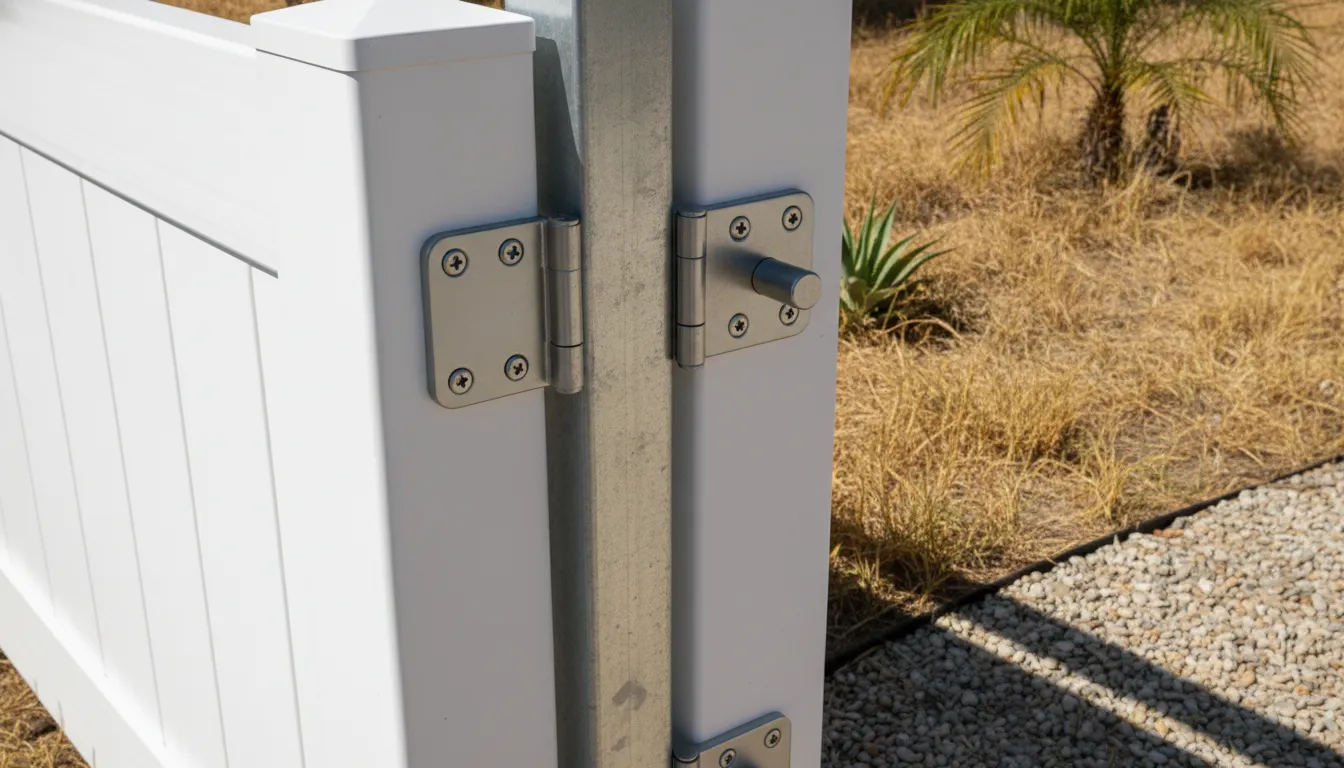
The right selection depends on the actual gate, not just the material. A pedestrian gate, a wide driveway gate, and a commercial entrance can have very different demands. Gate dimensions, traffic frequency, slope, exposure, and the surrounding posts all affect how the hardware should be chosen and installed. The vinyl fence posts guide is useful when evaluating the support structure around the opening.
| Component | Job | Selection questions | Warning signs |
|---|---|---|---|
| Hinges | Support the gate and control its swing. | Does the hinge arrangement suit the gate size, weight, swing direction, and post alignment? | Dragging, sagging, uneven gaps, or a gate that will not remain aligned. |
| Latches and handles | Keep the gate closed and provide a practical grip. | Will users approach from one side or both? Is the priority convenience, privacy, child safety, or controlled access? | The latch misses its strike, requires force, or can be reached when it should not be. |
| Drop rods | Help secure one leaf of a double or wide gate. | Does the gate need a fixed point when closed, and is the ground level enough for reliable engagement? | The rod does not seat fully, the ground opening shifts, or the gate moves when closed. |
| Self-closing components | Return the gate toward its closed position after use. | Is automatic closing appropriate for the location, users, and safety requirements? | The gate closes too quickly, fails to close, or creates a pinch or access problem. |
| Reinforcement | Help the gate resist flexing and maintain its shape. | Is the opening unusually wide, heavy, busy, sloped, or exposed to repeated operation? | Twisting, bowed members, loose connections, or hardware that repeatedly falls out of alignment. |
| Access controls | Manage entry for homes, pools, businesses, or shared properties. | Who needs access, from which side, and how will authorized users operate the gate? | Users bypass the intended entry point or the control conflicts with the gate’s movement. |
For a custom design, consider the opening, use case, and complete fence configuration together. A site assessment can confirm measurements, terrain, post support, hardware placement, and operating clearance before installation. That approach is especially important for wide, heavy, commercial, or high-traffic gates where a light-duty component may not be appropriate.
Should a Vinyl Gate Self-Close or Lock?
Self-closing and locking features solve different access problems, so the right choice depends on what the gate protects and how people use it. A self-closing gate returns toward the closed position after someone passes through. A locking latch or access-control device helps prevent unwanted entry. Some properties need one feature, while others need both.
Child and pool safety
For a gate near children, pets, or a pool area, self-closing hardware can reduce the chance that the gate is accidentally left open. The latch should engage reliably when the gate closes, and it should be positioned and operated in a way that fits the safety needs of the household. A self-closing mechanism is not a substitute for supervision or a complete safety review. It is one part of a gate system that also includes the opening, surrounding fence, latch placement, and how the gate is used.
Families comparing options may benefit from reviewing this child-safe gate latch guidance before selecting hardware. A professional can also check whether the gate swings freely, closes without dragging, and aligns with the receiving post.
Privacy, two-sided access, and everyday convenience
A locking latch may be useful when a gate separates a private yard from a sidewalk, shared driveway, or another area with regular foot traffic. Consider who needs to enter from each side. A latch that works from only one side may be appropriate for a controlled residential entry. But it can be inconvenient where family members, maintenance staff, or guests need access in both directions. Two-sided operation, an exterior handle, or a keyed option may be worth discussing when access needs are shared.
Privacy gates also need a practical balance between security and easy use. A gate that is difficult to open may encourage people to leave it unsecured or put unnecessary strain on the hinges and posts. Hardware should match the gate’s dimensions, weight, alignment, and traffic level rather than being selected as a generic kit.
Commercial control and professional assessment
Commercial properties, HOAs, and managed communities may need more consistent control over who enters and when. The decision could involve a lockable latch, controlled access, two-sided operation, or a combination of features. Appearance, uniformity, serviceability, and the surrounding fence design matter as much as the latch itself. HOA buyers should review their community requirements early. The California HOA fence rules resource can help frame that conversation, but it should not replace confirmation with the applicable association or local authority.
Ask for a professional assessment when the gate is unusually wide or heavy, sits on a slope, receives frequent traffic, serves a commercial property, or needs automated or controlled access. An on-site review can include measurements, terrain evaluation, hardware recommendations, and an operating test. This is especially prudent when an existing gate sags, fails to latch, or no longer meets the property’s safety or access needs.
What Should a Reliable Installation Proposal Include?
A useful proposal should make the project understandable before installation begins. It should connect the gate opening, surrounding fence, hardware, site conditions, and intended use instead of treating the gate as an isolated product. For a pedestrian gate, driveway gate, HOA project, or commercial entrance, the written scope should show what is being recommended and why.
-
Site assessment and intended use
The first step is an evaluation of the property and the gate’s purpose. The installer should discuss whether the opening serves pedestrians, vehicles, children, pets, pool access, a business, or a shared property. Traffic frequency, privacy, security, weather exposure, and service access can all affect the hardware selection. The assessment should also identify obstacles, existing fence conditions, nearby structures, and any unusual terrain. A sloped or constrained site may require a different approach from a straightforward level opening.
-
Verified measurements and configuration
The proposal should record the opening width, gate height, post locations, clearance, swing direction, and relationship to the existing fence. Standard vinyl gate models are commonly described as 4 to 6 feet high, but the actual dimensions and configuration should control the recommendation. Measurements should account for the gate frame, hinges, latch position, drop rod or other support, and the clearance needed for reliable operation. This is also where the installer should confirm whether the project calls for a single gate, a pair of gates, or a larger driveway opening.
-
Hardware and material specification
A complete proposal should identify the planned hinges, latch, handle, drop rod, self-closing mechanism, reinforcement, and any access-control components. It should explain how those choices fit the gate’s size, weight, traffic, safety needs, and security requirements. The surrounding fence and posts matter as well, so the recommendation should describe the complete configuration rather than list a one-size-fits-all kit. Finish, material, handing, and any required reinforcement should be clear enough for the owner to review.
-
Scope, compliance, and project terms
Look for a written scope that separates site preparation, post work, gate assembly, hardware installation, cleanup, and any repair or removal. It should identify permit, HOA, property-line, or utility-marking responsibilities when relevant. California’s CSLB C-13 classification covers construction, alteration, and repair of fences and gates. The proposal should also state material specifications, itemized costs, schedule assumptions, warranty terms, and what is excluded.
-
Testing and handoff
Before the project is considered complete, the installer should test gate operation, verify alignment, review safety items, and explain basic use and care. The handoff should confirm that the latch engages, the gate clears the surrounding fence, and any self-closing or access-control feature functions as intended. Written warranty terms should be reviewed, along with who to contact if adjustment or repair is needed later.
How Do You Maintain and Troubleshoot Gate Hardware?
Vinyl is a low-maintenance material, but the moving parts on a gate still need attention. Keeping the frame, hinges, latch, and surrounding posts clean makes it easier to spot a problem before the gate becomes difficult to use. Routine cleaning can usually be handled with soap and water or pressure washing, used carefully around hinges and latch openings. Vinyl does not require painting or staining, but hardware should still be checked for dirt, damage, and changes in operation.
Start troubleshooting by observing how the gate moves. If it drags along the ground or no longer meets the latch, check whether the gate has shifted, sagged, or encountered a change in grade. A sagging gate may point to a hinge, post, frame, or reinforcement issue rather than a simple latch adjustment. A gate that binds only at one point may also indicate that the opening or posts are no longer aligned. Do not force it, since repeated pressure can damage the hardware or vinyl components.
Common hardware problems and first checks
- Latch mismatch: Confirm that the latch and receiver meet at the same height and that the gate closes fully before the latch engages. A shifted gate may need alignment work rather than a new latch.
- Loose fasteners: Look for movement at hinge plates, latch mounts, handles, and reinforcement points. Fasteners should be tightened with care so the surrounding vinyl is not crushed or damaged.
- Sagging or dragging: Check the hinge side, gate clearance, posts, and any anti-sag support. A wide, heavy, or frequently used gate may require a more complete evaluation.
- Sticking or noisy movement: Remove dirt from contact areas and inspect the hinges for wear or damage. If cleaning does not restore smooth movement, replacement or adjustment may be appropriate.
When should hardware be repaired or replaced?
Repair may be practical when the hardware is intact and the problem is limited to alignment, fastening, or adjustment. Replacement deserves consideration when a hinge, latch, handle, or support is bent, cracked, worn, or no longer suited to the gate’s size and use. Changing one component without checking the complete configuration can leave the original cause unresolved.
A professional assessment is especially useful when the gate is sagging repeatedly, dragging on a slope, carrying frequent traffic, or failing to close securely. A G Vinyl Fencing provides installation, repair, adjustment, and upgrade services for residential and commercial gates. The vinyl fence gate installation guide explains the larger installation considerations, while the vinyl fencing supplies and repair guide offers related maintenance context.
Vinyl Gate Hardware in Anaheim and Orange County
Planning a gate in Anaheim or another Orange County community starts with the property, not a hardware package. Southern California conditions, the gate opening, traffic level, and the surrounding fence all affect the right combination of hinges, latch, handle, reinforcement, and closing hardware. Vinyl products are positioned for Southern California weather and do not require painting or staining. But the hardware still needs to be selected and installed for the way the gate will be used.
For a residential pedestrian gate, the priorities may be convenient entry, privacy, child safety, or access to a pool area. A driveway gate, wide opening, commercial entrance, or high-traffic gate can require a different assessment. Gate height, width, slope, post condition, clearance, and alignment should be reviewed before hardware is specified. Standard vinyl gate models are commonly described as 4 to 6 feet high, but actual dimensions and configuration matter more than a general size category. See the vinyl gate options before comparing hardware choices.
Check local requirements before installation
HOA rules may address appearance, height, location, materials, and consistency with neighboring improvements. Municipal requirements can also affect permits, property-line verification, utility marking, site preparation, and the planned gate location. Property managers and commercial owners may need a consistent design across multiple openings, clear access-control expectations, and documentation that matches the project scope. Reviewing these details early helps prevent a hardware choice that cannot be used at the site.
An on-site consultation can include measurements, terrain evaluation, material recommendations, design discussion, and a rough estimate. A formal proposal should then clarify the selected configuration, installation scope, options, timeline, and applicable warranty terms. A qualified installer can also test operation and verify alignment during handoff. A G Vinyl Fencing serves Anaheim, Fullerton, Orange, Placentia, Yorba Linda, Irvine, Tustin, Santa Ana. Garden Grove, and other Orange County communities, with more than 35 years of local operating experience. Review the Anaheim and Orange County service areas to confirm coverage.
Request a free estimate for your vinyl gate hardware and installation plan.
Frequently Asked Questions
What hardware does a vinyl fence gate need?
Most gates need hinges, a latch, and a handle. Depending on the opening and use, the system may also need a drop rod, self-closing mechanism, reinforcement, or access control. The right combination depends on the complete gate and fence configuration, not just the material of the gate.
How do I choose hinges for a vinyl gate?
Start with the gate’s actual width, height, construction, and expected traffic. A pedestrian gate may need a different hinge setup than a wide driveway or commercial gate. Post size, opening direction, slope, and whether the gate should self-close also affect the selection. Professional measurements help prevent alignment and clearance problems.
Should a vinyl gate have a self-closing latch?
A self-closing setup can be useful where the gate must return to a closed position after each use, including pool areas, child-accessible yards, and busy shared properties. The latch still needs to match the gate, surrounding fence, and access needs. Ask for an assessment when safety, privacy, or controlled entry is a primary concern.
Can the same hardware work on a residential and commercial gate?
Not always. Residential pedestrian gates typically have different traffic, security, and operating demands than driveway or commercial gates. Commercial and property-management projects may also require consistent appearance, documented options, and a more detailed scope. Hardware should be selected after reviewing the opening, traffic pattern, and maintenance needs.
When should vinyl gate hardware be repaired or replaced?
Persistent sagging, dragging, loose fasteners, a misaligned latch, or difficulty opening and closing are signs that the hardware or the supporting structure needs attention. Adjustment may solve a minor alignment issue, while damaged or undersized components may require replacement. A site assessment can separate a hardware repair from a larger gate or post problem.
Get Started With the Right Gate Hardware
The right hardware depends on how your vinyl gate will be used. The opening it must fit, and the level of access, safety, and traffic control your property needs. A project consultation can help turn those details into a practical gate plan for your Anaheim or Orange County property. Request a free estimate or consultation to discuss your vinyl fence gate project with the A G Vinyl Fencing team.
Gary Andreasyan is at the forefront of A G Vinyl Fencing, setting the standard for high-quality fencing solutions. His expertise in vinyl fencing has positioned the company as a go-to for durable, low-maintenance fencing options that enhance property value and security. Gary’s commitment to customer satisfaction and innovative fencing solutions drives A G Vinyl Fencing’s success, providing clients with a range of styles and designs that meet their specific needs and preferences.


0 Comments