


Vinyl fence HOA rules Orange County homeowners should check can affect the material, color, height, location, gate design, and approval timeline.
City or county review is separate from HOA approval. Neither one should be assumed from a neighbor’s existing fence. Collect the current rules, confirm the property’s jurisdiction, and submit a complete design package before ordering panels or scheduling installation.
Request an Orange County vinyl fence estimate | Ask about HOA-ready fence design
This homeowner checklist is designed for Anaheim and nearby Orange County communities. It explains what to look for in governing documents and how to separate private HOA rules from public permitting.
It also shows what to include in an architectural submission. Use it as a planning guide, then confirm the current requirements for your association, city, or unincorporated address.
What do vinyl fence HOA rules in Orange County usually cover?
Vinyl fence HOA rules in Orange County usually cover the fence’s appearance and placement, including approved materials, colors, panel styles, height, setbacks, gate details, and street-facing visibility. The exact standards come from the community’s CC&Rs, architectural guidelines, and application documents. A vinyl fence can be a practical low-maintenance choice, but the association may approve only specific profiles or finishes.
| Rule area | What to verify before drawing the plan | Common reason for review |
|---|---|---|
| Material and profile. | Whether vinyl is approved, plus privacy, picket, ranch, lattice, or other permitted styles. | Keeps the fence consistent with the community design. |
| Color and finish. | Approved colors, wood-look finishes, sheen, and whether color matching is required. | Prevents an installation that conflicts with the streetscape. |
| Height. | Maximum finished height for front, side, and rear areas, measured from the correct grade. | Protects visibility, access, and neighborhood appearance. |
| Location. | Property line, setbacks, easements, common areas, and distance from driveways or sidewalks. | Reduces encroachment and sight-line problems. |
| Gates and hardware. | Gate width, swing direction, latch, post caps, hinges, and visibility through the gate. | Addresses access, safety, and visual uniformity. |
| Maintenance and changes. | Cleaning expectations, replacement standards, and whether future modifications need another review. | Keeps the approved appearance in place over time. |
Do not treat a neighbor’s fence as proof that the same design is approved for your lot.
It may predate the current rules, have a written variance, or have been installed without approval. Ask the association or management company for the latest documents. Confirm any unclear point in writing.
Why are HOA approval and city review separate?
HOA approval addresses private community standards, while a city or county review addresses public zoning, safety, placement, and permit requirements. A permit does not make a design acceptable to an HOA, and an HOA cannot waive a public requirement. Treat both reviews as separate checkpoints, even when your project seems small.
California Civil Code Section 4765 addresses association approval procedures when governing documents require approval for a physical change. It calls for a fair, reasonable, and expeditious procedure, a good-faith decision, and a written decision.
If a proposal is disapproved, the written decision must explain why and describe the reconsideration procedure. Read the current statute at the California Legislative Information website. This article is general information, not legal advice.
That state procedure does not tell every Orange County HOA which vinyl color or fence height to approve. Your governing documents still control the association’s design review, and local rules still control the public side of the project. Keep copies of every submission, response, revision, and approval.
Which Orange County rules apply to your address?
Orange County is not one fence jurisdiction. The applicable public rules depend on the property’s city or unincorporated status. Anaheim, Fullerton, Orange, Placentia, Yorba Linda, and county service areas may use different processes.
Start with the property’s actual jurisdiction before relying on a permit statement found online or repeated by a neighbor.
For example, the City of Anaheim’s fence and wall zoning permit page says fences and walls seven feet or less do not need a building permit but do require Planning Division approval. It also asks applicants to show the full property, existing structures, fence location, height, and total length on a site plan. That is an Anaheim instruction, not a county-wide rule.
Properties in unincorporated areas should start with the Orange County Development Services building permit information and confirm whether the proposed fence needs a specific zoning, building, or related review. If the property is in another city, use that city’s current planning or building department guidance. Ask about corner-lot visibility, front-yard placement, pool barriers, easements, retaining walls, and any special overlay affecting the property.
For practical installation planning, the Orange County vinyl fence installation guide covers site conditions such as slopes, access, gates, old-fence removal, city rules, and HOA requirements. The point is not to memorize one county-wide number. It is to verify the rule set that applies to your lot.
How do corner lots, driveways, and slopes change the review?
Corner lots, driveway approaches, slopes, and fences near sidewalks often receive extra attention because the finished fence can affect visibility. Access, drainage, and the appearance of the public edge. Show these conditions on your plan instead of assuming a standard straight run will be accepted.
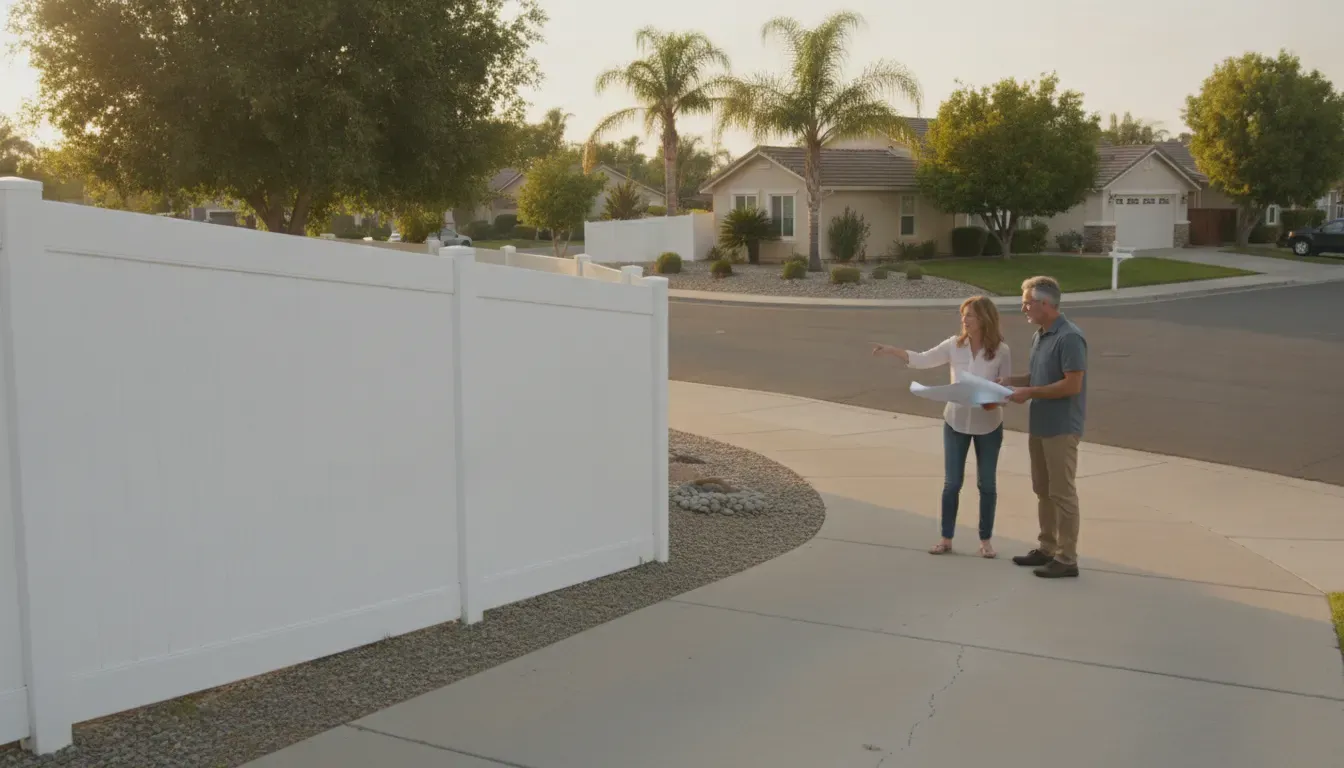
- Corner lot: Ask the city or HOA how height, openness, and setbacks are measured near the street intersection.
- Driveway: Confirm that a gate will not interfere with vehicle access, sidewalks, sight lines, or utility equipment.
- Slope: Decide whether the approved design will step with the grade or follow a slope, then show the finished height at relevant points.
- Existing wall or retaining feature: Clarify whether the fence is attached to, placed behind, or structurally independent of the existing feature.
- Pool or spa: Confirm whether the fence is part of a required barrier and whether gate hardware or openings must meet additional safety standards.
When measurements are uncertain, resolve the property line and easement questions before the HOA review. An attractive fence in the wrong location can create a much larger problem than a design revision.
What should be in a vinyl fence HOA application?
A strong vinyl fence HOA application shows exactly what will be built and where it will sit. It should show the height, both sides, and gate operation. A complete package gives the reviewer a clear answer without requiring several rounds of follow-up.
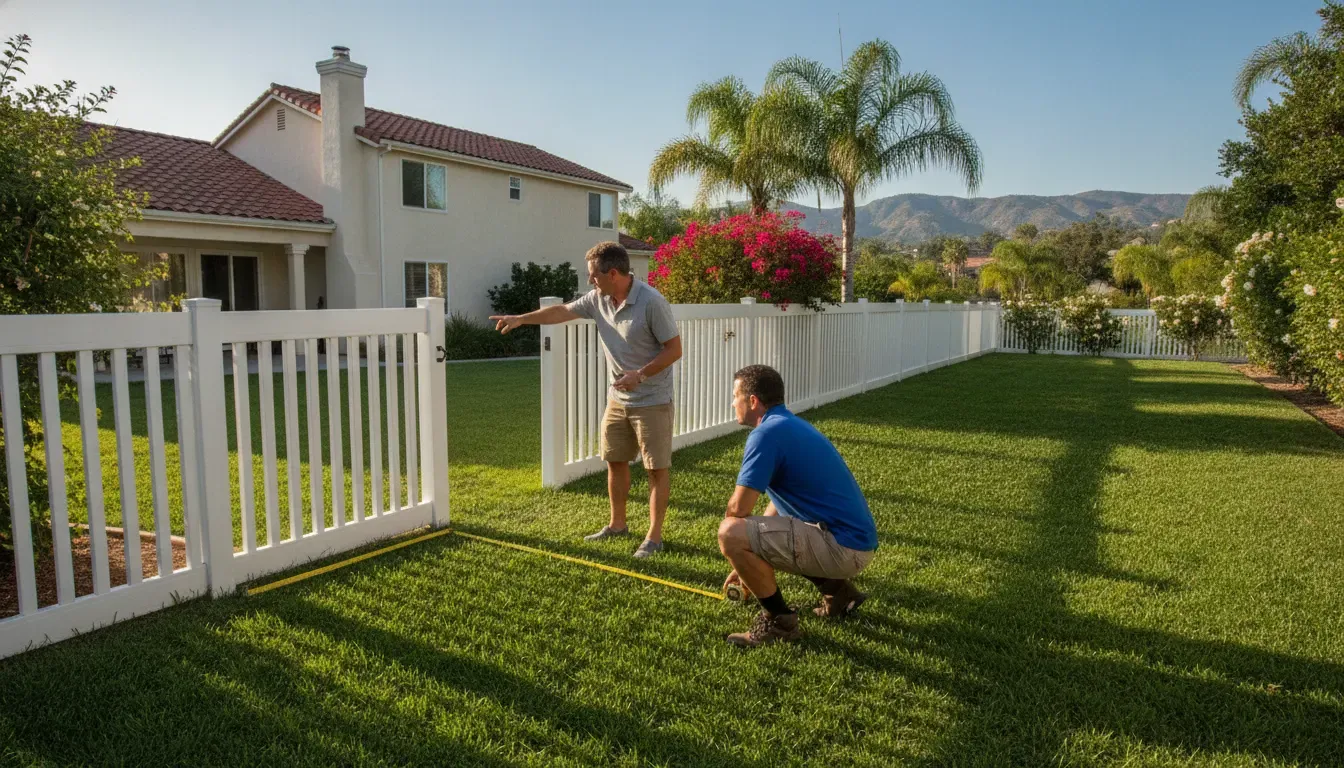
- Current governing documents: Use the association’s latest CC&Rs, architectural standards, application form, fee schedule, and submission instructions.
- Site plan: Mark property lines, existing structures, fence runs, gates, dimensions, setbacks, streets, sidewalks, driveways, pools, slopes, and easements when relevant.
- Elevation or product view: Identify the vinyl profile, panel height, post spacing, post caps, rails, lattice or picket details, and the finished side facing the street.
- Color and finish information: Name the proposed color and finish, and include a product sample or manufacturer information if the association requests it.
- Gate details: Show width, location, swing, latch, hinges, and any self-closing or pool-safety feature that applies.
- Photos: Include the existing fence line, nearby homes, the street view, driveway approach, corner condition, and any grade change.
- Project contact: List the homeowner and contractor contact details, anticipated installation sequence, and any requested neighbor notice.
Use clear, consistent measurements. If the application asks for height, show finished height from grade rather than only the panel’s nominal size. If a rule is unclear, ask the HOA for a written interpretation before submitting a design that may need to be redrawn.
How should you choose a vinyl fence design before submitting?
Choose the vinyl fence design by matching the HOA’s approved appearance first, then balance privacy, visibility, access, and maintenance for the property. The most attractive design is not useful if its color, height, top detail, or gate hardware falls outside the association’s published standards.
Start with the purpose of each fence run. A solid privacy panel may suit a rear yard, while an open picket style may work better at a front-facing area where the community values visibility. A gate should be considered at the same time as the panel layout so its width, hardware, and swing are shown consistently in the application.
For material background, the PVC vinyl fencing guide explains durability, low maintenance, styles, colors, and selection considerations. A G Vinyl Fencing can help translate an approved design into a buildable layout, but the HOA’s written rules and the local authority’s requirements remain the controlling sources.
Review the fence’s relationship to the rest of the property as well. Check the street-facing side, neighboring fence connections, landscape clearance, irrigation, utility access, and any planned gate. If your project includes a separate gate decision, see the custom vinyl gates service page for the types of gate configurations that may need to be shown in the plan.
What should you do if the HOA denies or delays the request?
If an HOA denies or delays a fence request, ask for the decision and the reason in writing. Compare the response with the governing documents, and use the stated reconsideration or appeal process before changing the project. Do not start construction because a verbal conversation sounded favorable, and do not assume silence means approval unless the governing documents and applicable law clearly say so.
First, confirm whether the association considers the application complete. A missing site plan, color sample, product sheet, or gate detail may be a fixable submission problem. Second, ask the reviewer to identify the exact rule or design standard at issue. Third, revise only what is necessary and keep a dated record of the resubmission.
When Section 4765 applies, a disapproval should be in writing and include an explanation and the reconsideration procedure.
If the issue involves a boundary, easement, public safety requirement, a dispute with a neighbor. Or a potential enforcement action, get advice from a qualified California property or HOA attorney. A fencing contractor can help with measurements and constructability, but cannot replace legal advice or the association’s official decision.
Orange County vinyl fence HOA rules: a homeowner checklist
Use this sequence before you order materials: identify the rule set, confirm the design boundary, prepare the documents, secure written approvals, and only then schedule installation. This order reduces the chance of paying for a design that must be changed or removed.
- Identify the HOA, management company, and public jurisdiction for the property.
- Request the current CC&Rs, architectural rules, application, fee schedule, and review calendar.
- Confirm the approved vinyl materials, profiles, colors, finishes, heights, post caps, and gate hardware.
- Check the property line, easements, setbacks, utilities, slopes, corners, driveways, sidewalks, and pool conditions.
- Ask the city, county, or planning department whether zoning approval, a permit, or a specific site plan is required.
- Measure the fence runs and gates, and show finished height from grade where conditions change.
- Prepare the site plan, photos, elevations, product information, color sample, and gate details.
- Submit the complete package through the HOA’s required channel and keep proof of delivery.
- Wait for written HOA approval and complete any required public review before ordering or building.
- Confirm that the final installation matches the approved drawings, including height, color, gate location, and street-facing appearance.
For homeowners comparing installation options, A G Vinyl Fencing provides vinyl fence installation in Anaheim and serves surrounding Orange County communities. The team has more than 35 years of local installation experience and can discuss how an approved design may translate to a practical fence layout.
Send your HOA documents and request a vinyl fence estimate.
Plan your Orange County fence project.
Frequently Asked Questions About Orange County HOA Fence Rules.
Do I need HOA approval for a vinyl fence in Orange County?
If your property is governed by an HOA and its documents require approval for exterior changes, you generally need written approval before installing or changing a fence. Check the current CC&Rs and architectural application rather than relying on a neighbor’s project.
Does a city permit replace HOA approval?
No. A city or county review and an HOA architectural review are separate. A public agency checks applicable zoning, safety, and placement requirements, while the HOA checks private design standards. A project may need one, both, or neither depending on the address and governing documents.
Are vinyl fences allowed by Orange County HOAs?
Some communities allow vinyl fencing, but approval depends on the association’s current rules and the proposed profile, color, height, location, and gate details. Submit the exact product information for review instead of assuming that all vinyl styles are treated the same.
What should I submit with an HOA fence application?
Most applications need a site plan, dimensions, photos, fence and gate details, material and color information, and any requested contractor or neighbor information. Follow the association’s current form and include the finished height and placement clearly.
How long does HOA fence approval take?
The timeline depends on the association’s review procedure, meeting schedule, application completeness, and whether revisions are requested. Ask for the maximum response time and submission calendar in the current architectural guidelines, then wait for written approval before ordering materials.
Can A G Vinyl Fencing help with an HOA fence project?
A G Vinyl Fencing can discuss vinyl styles, measurements, gates, and installation planning for Anaheim and Orange County projects. The homeowner remains responsible for submitting the HOA application and confirming public requirements. Start with the contact page to request an estimate.
Once your HOA documents, site conditions, and public review requirements are clear, contact A G Vinyl Fencing for a site-specific vinyl fence estimate and a practical path from approved design to installation.
Gary Andreasyan is at the forefront of A G Vinyl Fencing, setting the standard for high-quality fencing solutions. His expertise in vinyl fencing has positioned the company as a go-to for durable, low-maintenance fencing options that enhance property value and security. Gary’s commitment to customer satisfaction and innovative fencing solutions drives A G Vinyl Fencing’s success, providing clients with a range of styles and designs that meet their specific needs and preferences.


0 Comments