


Choosing a fence in Orange County is not only a question of color or height. The right result starts with understanding how the yard is used and where the property line sits. Then consider local or HOA rules and how a gate should work every day. Homeowners searching for ag vinyl fencing are often trying to understand both the product and the experience of working with a local installer.
Talk with A G Vinyl Fencing about your project
A G Vinyl Fencing is based in Anaheim and serves Orange County and surrounding Southern California communities. Its residential process is designed to move from an initial conversation and site assessment to material selection, measurements, a written proposal, preparation, installation, inspection, and a customer walkthrough. Vinyl may be the best fit for a private, low-maintenance boundary. Aluminum or glass can make more sense when visibility, pool design, or an outdoor-living connection is the priority.
This guide explains what to prepare, what to ask, and what to expect at each stage. It focuses on practical decisions for homeowners in Anaheim, Fullerton, Orange, Placentia, Yorba Linda, Irvine, and nearby Orange County communities.
How A G Vinyl Fencing Plans Your ag vinyl fencing Project
A useful fence plan begins with the property, not a catalog. During the first conversation, explain what you want the fence to accomplish. Privacy, a safer area for children or pets, a clearer boundary, pool separation, curb appeal, and access for vehicles or guests can lead to different layouts. Sharing photos of the yard, a rough idea of the fence line, and any HOA documents can make the discussion more productive.
The on-site assessment is where general ideas become a site-specific plan. The team can review the yard, take measurements, consider terrain, and discuss material recommendations. The customer operations brief describes this assessment as approximately 60 to 90 minutes, although the actual time depends on the property and the questions that need to be answered. Slopes, existing concrete, landscaping, drainage, side-yard access, and the location of an existing gate can all affect the design.
- Identify the purpose of each fence run, such as privacy, pool safety, pet containment, or decoration.
- Review the likely fence line and confirm which areas need a gate or service access.
- Discuss height, color, panel style, post caps, and how the fence will meet the home.
- Note property-line, HOA, utility, permit, grading, and removal questions that may need follow-up.
A G Vinyl Fencing describes itself as a family-based and locally operated business in Anaheim and Orange County, with more than 35 years of combined experience. That local context matters because a plan has to work with the actual yard, not just look good in a product photo. The company’s stated service territory includes Orange County and surrounding areas, with Anaheim as its base.
After the visit, ask how the measurements and design decisions will appear in the proposal. A clear process should make it possible to distinguish the fence length, gate locations, material, height, finish, site preparation, and any approval-related work. This is also the right time to bring up a future patio cover, deck, railing, or other outdoor-living feature so the fence does not block a later improvement.
How to Choose a Vinyl Fence Style, Height, and Color
Once the fence line is understood, design choices should follow the way each part of the property is used. A privacy panel can create a more enclosed backyard, while a picket style can define a front yard without closing it off. Split-rail designs offer a more open boundary. Pool fencing has an additional safety purpose, so the gate, access pattern, and applicable local requirements deserve careful review before choosing an appearance.
Four to six feet are common residential vinyl fence heights, but the right height depends on the intended privacy. The location, sight lines, neighborhood context, and any rules that apply. A tall panel along a side yard may solve a privacy problem, while a lower front-yard design may preserve visibility and fit the streetscape more comfortably. Think about transitions at corners and where a fence meets a wall, driveway, patio, or planting bed.
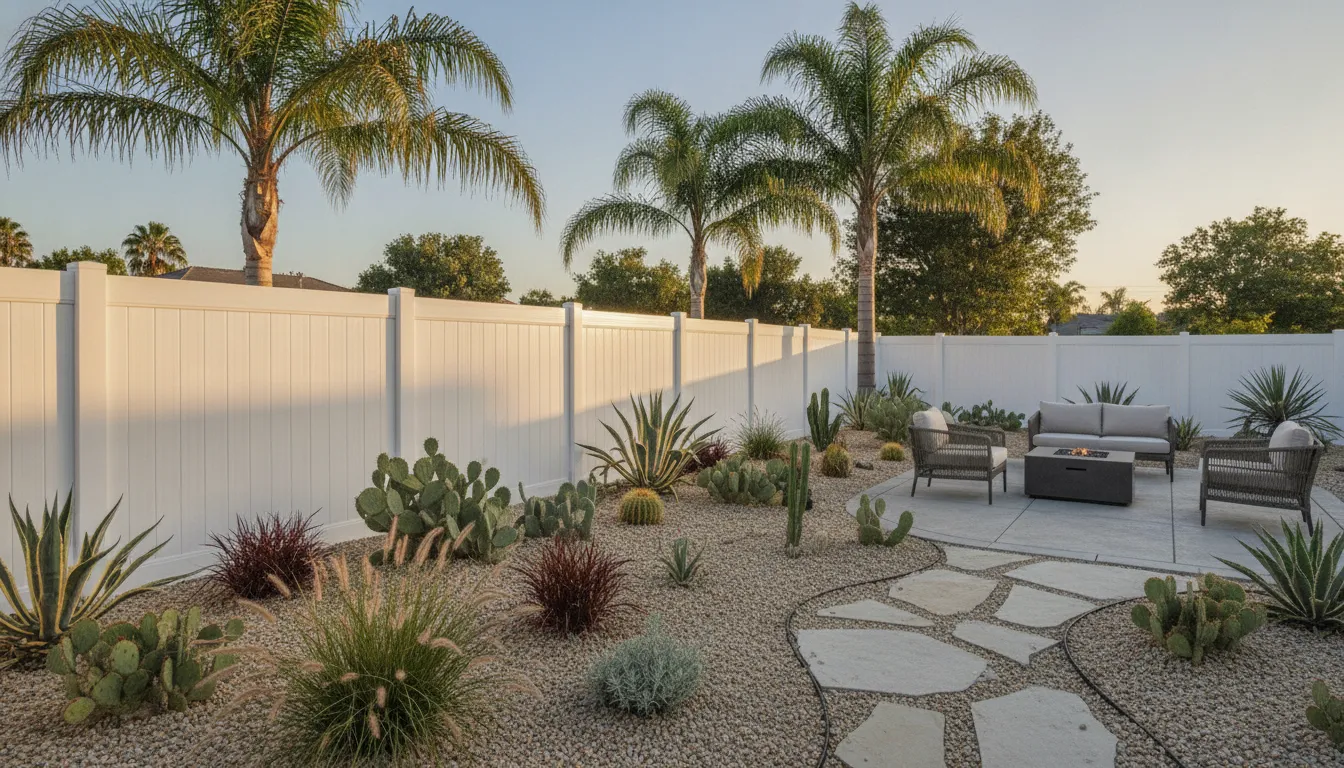
Color should coordinate with the exterior rather than be chosen in isolation. A G Vinyl Fencing’s homepage states that more than 12 color options are available. Look at samples in the property’s daylight and compare them with stucco, trim, roofing, hardscape, and landscaping. Homeowners considering a wood-look or darker finish can review this dark brown vinyl fence design guide, while a broader vinyl fencing colors guide can help organize the decision.
- Privacy: consider solid panels, the viewing direction, and whether the fence surrounds the entire yard or only a key area.
- Front-yard appearance: compare picket spacing, post caps, and the relationship to the sidewalk and entry.
- Gate access: allow enough clearance for people, bins, equipment, or vehicles where needed.
- HOA review: confirm color, height, style, and placement rules before materials are ordered.
Use the vinyl fence style options resource for additional product-planning ideas. The goal is a design that supports privacy and access while still looking intentional from both sides of the property.
When Vinyl Is the Right Fit, and When Aluminum or Glass Makes Sense
Vinyl is a strong starting point when the homeowner wants a defined boundary, privacy, and simple routine care. It can be used for privacy, picket, split-rail, pool, pet, and selected commercial applications. The company describes its vinyl materials as designed for Southern California conditions, including resistance to fading and cracking. Those are product-positioning statements, so confirm the specifications for the selected system during the consultation.
Material selection becomes clearer when the purpose of the fence is written down. Use the comparison below as a conversation starter rather than a substitute for measuring the property.
| Material | Often considered for | Questions to ask |
|---|---|---|
| Vinyl | Privacy, pet areas, front-yard boundaries, and low-maintenance layouts | Which panel height, color, style, and gate arrangement suit the yard? |
| Aluminum | Open sight lines, defined boundaries, and selected security or pool applications | Where is visibility important, and what finish and spacing fit the setting? |
| Glass | Railing and outdoor-living areas where preserving a view is central | What safety, mounting, cleaning, and structural requirements apply? |
| Composite decking | Deck surfaces that connect a fence project with a broader outdoor-living plan | How should the fence, deck, gate, and railing transitions be coordinated? |
A G Vinyl Fencing offers vinyl and aluminum fencing, glass fences and railings, and composite decking. That broader material range can be useful when one property has several needs. For example, a homeowner may prefer a solid vinyl side-yard boundary but want a more open aluminum section near the front. A deck or elevated patio may call for a railing conversation rather than a fence conversation.
Vinyl also has tradeoffs. Extension guidance describes it as low maintenance, weather-resistant, and resistant to warping or splintering. While noting that it can cost more upfront and may offer fewer customization options than wood. This article does not provide an invented project price. Instead, ask the installer to explain how material, linear footage, gates, removal, grade changes, access, and approvals affect the estimate. The best material is the one that satisfies the site’s purpose and the homeowner’s maintenance expectations.
What Happens Before Installation in an Orange County Yard
Most installation problems begin as planning problems. Before materials arrive, the proposal should turn the site visit into a clear scope of work. It should identify the fence runs, approximate measurements, selected style and height, gate locations, removal or grading needs, and the responsibilities of the homeowner and installer. It should also state which approvals or site conditions remain to be confirmed.
Property lines deserve special attention. A boundary fence can affect two properties, so do not rely only on a visual guess from an old fence. If the line is uncertain, ask what documentation or professional confirmation is appropriate before posts are placed. The same caution applies to easements, walls, irrigation, drains, and buried utilities.
Depending on the city, neighborhood, location, and project scope, the preparation stage may include municipal permitting, HOA review, utility marking, or neighbor notification. These are not universal requirements. Ask who will coordinate each item, what must be approved before ordering, and whether the schedule changes while an approval is pending.
- Confirm the fence line, corners, transitions, and gate swing before digging.
- Review access for workers, equipment, material delivery, and debris removal.
- Mark existing fence sections, landscaping, concrete, grading changes, and drainage features that may affect the layout.
- Coordinate utility marking before post-hole locations are finalized.
- Confirm the selected material, color, height, panel style, caps, hardware, and cleanup plan in writing.
Site preparation may include removing an existing fence, leveling or grading portions of the yard, and marking post holes. A homeowner can help by clearing movable items, identifying irrigation controls, securing pets, and making the access route available on the agreed installation dates. The vinyl fencing installation supplies guide offers additional background on the parts and materials that may appear in a project discussion.
A careful preparation phase protects the design. It also gives the homeowner a fair opportunity to ask about changes before the crew begins. When a revision is usually easier to explain than after posts or panels are installed.
What to Expect During Vinyl Fence and Gate Installation
Installation turns the approved plan into a working fence. The exact sequence varies with soil, grade, access, removal, weather, and the chosen system, but a typical residential project follows a recognizable path. Ask the crew lead to review the first-day layout and confirm any questions before digging starts.
- Lay out the fence line. Post and gate locations are marked from the approved measurements. Corners, transitions, and clearance around gates are checked before excavation.
- Prepare and set the posts. Post holes are created for the site conditions, and posts are aligned and secured. Manufacturer instructions and the selected product specifications guide the work.
- Install the panels and rails. Once the post layout is ready, the fence sections are fitted, leveled, and connected. The crew checks how the system follows grade and meets existing surfaces.
- Fit the gates and hardware. Gates are installed with attention to swing, latch position, clearance, and daily access. Walk through how the gate should operate before closeout.
- Inspect and complete the site. Alignment, connections, gate operation, safety considerations, and cleanup are reviewed. The homeowner receives a walkthrough and care guidance.
A G Vinyl Fencing lists vinyl gates as part of its service offering and states that installations typically take one to three days depending on the project. Treat that as a general planning reference, not a promise. A longer fence line, difficult access, removal work, grade changes, multiple gates, or required approvals may affect the schedule.
Ask whether the proposal explains how posts are set, how the crew handles transitions, and how a gate is adjusted if the ground changes across the opening. You can also ask what inspection or quality check happens before the crew leaves. The company describes itself as licensed, bonded, and insured and lists California contractor license number 1059119 on its homepage. Homeowners should still confirm current license and insurance information as part of their normal hiring process.
At the final walkthrough, test every gate, look along the fence line from both sides, and note any questions about cleaning or future adjustments. The installation is not complete from a homeowner’s perspective until the fence is both visually consistent and practical to use.
How to Maintain Vinyl Fencing After the Crew Leaves
Vinyl is often selected because it avoids routine painting and staining. Extension guidance describes vinyl fencing as a low-maintenance alternative to wood. And A G Vinyl Fencing describes its vinyl materials as designed to resist fading and cracking in the Southern California climate. Maintenance is still worthwhile because dirt, plant growth, irrigation overspray, impact, and gate movement can affect the appearance and function of any outdoor installation.
- Rinse away loose dust and check whether soil or lawn clippings are collecting at the base.
- Use soap and water for ordinary buildup, following the product manufacturer’s care instructions.
- Use pressure washing only at a suitable setting and distance for the selected product.
- Inspect gates for dragging, loose hardware, latch alignment, and changes in clearance.
- Trim plants that press against panels or block gate movement.
- After strong wind or accidental impact, look for movement, cracked components, or shifted posts.
Cleaning needs depend on the property’s exposure. A fence near sprinklers, a dusty street, a pool, or dense landscaping may need attention sooner than a sheltered side yard. Avoid assuming that every cleaner is safe for every finish. Test any product in an inconspicuous area only when the manufacturer’s instructions allow it, and ask the installer what to avoid.
Routine care is also a good time to document a concern. Take a clear photo, note where it occurred, and describe whether the issue affects appearance, stability, or gate operation. If the work is covered by a workmanship warranty, ask how a service request should be submitted and what terms apply. Do not confuse a workmanship warranty with a product warranty or a claimed product lifespan. The customer context supports using the phrase standard one-year workmanship warranty, while product-specific terms should be confirmed in the proposal or manufacturer documents.
For a deeper look at parts, cleaning, and repairs, review the vinyl fencing installation supplies resource and the white vinyl fence maintenance guide. Keeping the fence clean and the gates adjusted helps preserve the finished design and makes small issues easier to catch.
What Your A G Vinyl Fencing Estimate Should Explain
An estimate is more useful when it explains the work, not just the final number. Whether the project is a small front-yard update or a larger privacy installation, the written scope should let you compare options without guessing what has been left out.
- Layout and measurement: identify the fence runs, corners, transitions, approximate linear footage, and any assumptions about the property line.
- Material selection: list the material, height, color, panel style, post caps, rails, and product-specific specifications.
- Gate details: show the number of gates, opening direction, hardware, latch, clearance, and any vehicle or access needs.
- Site work: explain removal, grading, concrete, difficult access, landscaping protection, debris removal, and cleanup.
- Approvals: note whether municipal permits, HOA review, utility marking, or neighbor coordination may apply and who handles each step.
- Schedule: give a project-dependent installation window and identify factors that could change it.
- Warranty terms: separate workmanship coverage from manufacturer product terms and state the applicable conditions.
A G Vinyl Fencing says it provides free estimates and offers a design-to-installation service model. Its public materials identify Anaheim as the base and Orange County as a core service area. The company’s stated experience and service claims should be verified as part of any homeowner’s normal comparison process. Just as you would verify scope, insurance, licensing, and references for another contractor.
When comparing proposals, ask the same questions of each installer. What happens if the fence line changes after measurement? Are gates included in the stated scope? Who confirms HOA or city requirements? How will a slope or existing concrete be handled? What care instructions will you receive? These questions reveal differences in planning and service that a headline price cannot show.
If the project also includes a patio cover, deck, railing, or another outdoor-living feature, mention it before the design is finalized. Coordinating the relationship between these elements can prevent awkward transitions and preserve access.
Request a free vinyl fence estimate
Frequently Asked Questions
What are the negatives of vinyl fencing?
Vinyl can have a higher upfront cost than some alternatives, and customization may be more limited than wood. It is also important to choose a style, height, color, and installation method that suit the property. Ask for product specifications and care instructions rather than assuming every vinyl system performs the same way.
How much does a 100 foot vinyl fence cost installed?
There is no responsible universal price for a 100-foot fence. The estimate can change with height, panel style, gates, property access, removal, grade, soil, concrete, approvals, and cleanup. A site assessment and written scope are the best way to understand the cost of a specific Orange County project.
What is the best brand of vinyl fence?
The best choice depends on the intended use, available styles, material specifications, warranty terms, and the installer’s ability to plan the site correctly. Compare the selected product’s construction and care requirements, then evaluate the complete proposal rather than choosing by brand name alone.
Who has the cheapest vinyl fencing?
The lowest initial quote may not include the same materials, gate hardware, preparation, removal, approvals, or cleanup as another proposal. Ask each installer for an itemized scope so you can compare the same work. A clear local estimate is more useful than a price ranking without project details.
For a project-specific discussion, review the fence line, access needs, material preferences, and gate requirements with the installer before selecting a system.
Ready to discuss a fence for your Orange County property? Share your goals, approximate layout, preferred material, gate needs, and any HOA or access questions with A G Vinyl Fencing. The team can use that information to guide the next planning step and prepare a project-specific estimate.
Contact A G Vinyl Fencing for a free estimate
Gary Andreasyan is at the forefront of A G Vinyl Fencing, setting the standard for high-quality fencing solutions. His expertise in vinyl fencing has positioned the company as a go-to for durable, low-maintenance fencing options that enhance property value and security. Gary’s commitment to customer satisfaction and innovative fencing solutions drives A G Vinyl Fencing’s success, providing clients with a range of styles and designs that meet their specific needs and preferences.


0 Comments