


4ft Vinyl Fencing for Orange County Front Yards
Choosing 4ft vinyl fencing for an Orange County front yard can give you a visible property boundary, a finished landscape edge, and a practical place for pets without hiding the home. The best result comes from matching the height and profile to the street view, front setback, architecture, planting, gate use, and approval requirements. This guide explains the main decisions, planning ranges, and HOA steps. You can compare a four-foot design with taller alternatives before ordering materials.
Request a 4ft vinyl fencing estimate
Short answer: 4ft vinyl fencing is usually a strong fit for an open, decorative front-yard boundary when curb appeal and visibility matter more than full privacy. The right choice still depends on your pet, lot layout, local rules, HOA standards, and the exact panel and gate design.
Four feet is not universal. Confirm the pet, privacy goal, lot, and approvals before ordering.
Why 4ft Vinyl Fencing Works for Orange County Front Yards
Answer: A four-foot fence defines the front yard while preserving sightlines to the house, landscaping, and street. This balance is especially useful on compact lots, landscaped entries, and open neighborhood streetscapes.
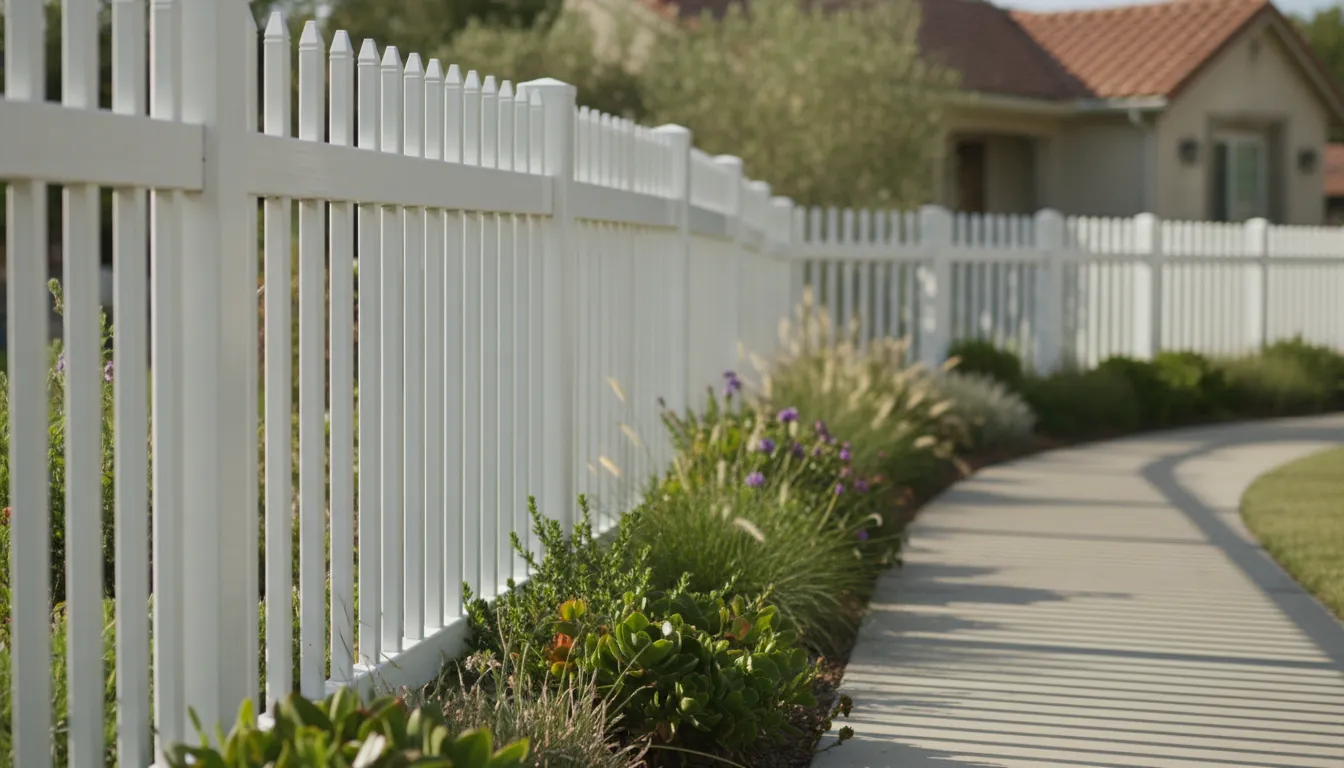
A front-yard fence influences more than the property line. It frames the front door approach and shapes the sidewalk view. A four-foot vinyl fence can outline a lawn, separate a planting bed, or guide visitors toward a gate without creating a tall visual wall.
Orange County properties vary widely. A bungalow in Santa Ana may have a short setback and narrow walkway. A corner property in Irvine may have more frontage but added visibility concerns. A coastal lot in Huntington Beach or Newport Beach may combine salt air, bright sun, mature landscaping, and HOA standards. The lot and street view shape the result.
Open visibility can support curb appeal
The main visual benefit is openness. A low fence keeps the front elevation, windows, porch, and landscape visible from the street. It can help a compact yard feel connected rather than enclosed. Established shrubs, ornamental grasses, trees, and pathway materials remain part of the property’s design instead of disappearing behind solid panels.
Choose a profile that supports the home’s existing lines. A traditional house may suit evenly spaced pickets and simple post caps. A contemporary exterior may look better with a flat top, restrained posts, and a color that relates to the trim or hardscape. A fence should appear planned with the house, not placed in front of it as an unrelated object. Browse vinyl fencing options and the company’s residential vinyl fencing services before selecting a profile.
Pet containment requires more than a height
Four feet can help contain many dogs and can create a clear boundary for supervised outdoor routines. It can discourage a pet from moving toward the sidewalk, give children a defined play area, and make a front gate easier to manage. It is not a guarantee of containment. A dog’s size, athletic ability, digging behavior, temperament, and relationship to nearby walls or planters all matter.
Inspect the complete route, not just the panel height. Look for gaps below sections, objects that could act as a step. Tree boxes beside the fence, and gate hardware that a clever dog could push or nose open. A determined jumper may need a taller or differently configured enclosure. Discuss latch height, closing force, and gate placement when reviewing vinyl gate options. Supervision and training remain necessary even when the fence is well designed.
Know when a taller or more private design is better
A four-foot fence is less suitable when your primary goal is privacy around a front porch, seating area, or street-facing window. A taller run or a more private panel may provide stronger screening, although it can also block views, change the street appearance, and receive closer review. For a side or rear boundary, a six-foot design may be more useful than a low front-yard profile. Review a 6-foot vinyl fence guide when screening is more important than an open frontage.
Which 4ft Vinyl Fence Styles Fit an Orange County Home?
Answer: Picket, flat-top, and open or semi-private profiles can work well at four feet. Select the style by comparing the home’s architecture, landscape scale, desired visibility, gate use, and the design language required by the neighborhood or HOA.
Style is not merely a color choice. Picket spacing, rails, post caps, the top line, gate shape, and nearby plants determine whether a fence feels classic, modern, formal, or casual. Orange County front-yard designs need to look attractive from the sidewalk while remaining useful inside the property.
| Style element | Potential fit | Planning question |
|---|---|---|
| Picket profile | Traditional, cottage, or bungalow exteriors | Will the spacing keep the yard open and complement existing trim? |
| Flat-top line | Contemporary homes and clean landscape plans | Does the simple top line match the facade and hardscape? |
| Open or semi-private panel | Light separation near a sidewalk or entry | Does it provide enough definition without conflicting with visibility rules? |
| Color and cap | Coordinated exterior design | Does the finish relate to siding, trim, stone, paving, and plants? |
| Gate configuration | Walkways, side access, and pet routines | Will the opening, swing, latch, and clearance work every day? |
Use the house and landscape as design references
Start at the street and view the property from several angles. Note the roof line, windows, front door, porch columns, driveway, and strongest landscape features. A four-foot fence generally looks more integrated when its post spacing and top line echo an existing rhythm. Avoid placing a post where it would interrupt an important view or crowd a narrow walkway.
Landscape scale matters too. Small front yards can feel crowded with oversized posts or heavy caps. Wider corner lots may need returns or separate gate zones. Account for mature roots, irrigation, and future plant growth before finalizing the route.
Compare pickets, panels, colors, and caps together
Open pickets can support a traditional front-yard look and make the home more visible. A flat-top line can be quieter against a modern facade. Semi-private panels can create more separation but may feel heavier than expected at a small setback. Review the vinyl fencing color guide with a photo of your exterior rather than choosing a sample in isolation. Sunlight, stucco, stone, and surrounding greenery can change how a finish reads.
For a classic boundary, compare vinyl picket fencing profiles with the width of the walkway and the scale of the porch. For a more controlled access point, plan the gate with the fence instead of adding it later. The gate should have a usable opening, a swing that does not strike a wall or plant, and a latch that fits the people and pets using it.
Account for corner lots and front-yard visibility
Corner lots deserve an extra review because drivers and pedestrians may see two elevations of the fence. A return near a driveway can affect sightlines, and a gate placed near a corner may be less convenient or subject to additional rules. Measure the frontage, identify sidewalks and drive approaches, and ask the local department whether a visibility triangle or setback applies. In a planned community, show both street-facing elevations in the HOA package.
How Much Does 4ft Vinyl Fencing Cost to Plan?
Answer: Customer planning guidance for installed 4ft vinyl fencing uses a range of about site-specific planning range, with gates and site conditions considered separately. Treat those figures as budgeting ranges, not a quote or guaranteed project total.
Budgeting should begin with the approximate fence line, but linear footage is only one part of the scope. Profile, corners, gates, removal, grade, access, labor, and approval revisions can all affect the estimate. A short, complex run may require more planning than a longer straight run.
For a customer-context planning example, a 200-linear-foot residential project should be scoped from the measured fence line, selected profile, gates, preparation, and site conditions. This is early budgeting guidance, not a promise. Confirm the design, measurements, gates, preparation, and site conditions before relying on a total.
Separate fence-line costs from gate and preparation costs
Installed pricing may include panels, posts, rails, fasteners, layout, labor, and ordinary setting work. Removal, disposal, obstructions, grading, unusual access, corners, and custom sections may change the scope. Ask the installer to list those items separately so proposals can be compared fairly.
Gates also deserve their own line item. Customer guidance places a standard vinyl gate planning range at approximately site-specific planning range, depending on size, hardware, design, and installation conditions. This is a range for planning, not a guaranteed charge. Count pedestrian, side-access, and wider equipment gates before requesting an estimate. The vinyl fencing cost planning guide can help organize linear footage, and A G Vinyl Fencing’s service overview plus its repair planning resource can help frame the scope discussion.
Site conditions that can move the estimate
- Existing fence: Removal, disposal, and cleanup may be separate from new installation.
- Grade: Slopes and elevation changes can require additional layout and section planning.
- Access: Narrow walkways, walls, landscaping, and limited staging space may affect labor.
- Layout: Corners, returns, ends, transitions, and special sections add measurement points.
- Gates: Width, swing, hardware, latch location, and clearance affect the final scope.
- Approvals: HOA revisions, permits, or required changes can affect both materials and schedule.
Before comparing numbers, photograph the route, measure the openings, and mention slopes or old fence removal. Include HOA documents or style restrictions. This lets a contractor separate the fence allowance from gates, preparation, removal, and possible changes.
4ft vs. 6ft Vinyl Fencing: Which Height Fits Your Yard?
Answer: Choose 4ft vinyl fencing when openness, curb appeal, and a visible boundary lead the decision. Consider six feet when privacy or stronger separation leads, then confirm that the taller design fits the front-yard rules, architecture, and lot layout.
Height should follow the job the fence must perform. Four feet can frame planting, guide visitors, and help define a pet area while leaving much of the home visible. Six feet can screen more effectively, but it may also make a front setback feel smaller and hide landscape investment. Neither height is automatically better.
| Priority | 4ft vinyl fencing | 6ft vinyl fencing |
|---|---|---|
| Street visibility | Preserves more of the home and front landscape. | Creates a stronger visual barrier from the street. |
| Privacy | Provides limited separation and depends heavily on panel design. | Generally provides more screening when private panels are allowed. |
| Curb appeal | Often supports open, decorative, or traditional frontage. | Can look substantial and may compete with a small front elevation. |
| Pets | May work for some animals when the entire perimeter is planned. | May suit larger or more athletic pets, but gaps and gates still matter. |
| HOA review | May fit communities that favor open front-yard streetscapes. | May receive closer review for height, setbacks, and visibility. |
Choose four feet for an open, designed edge
A low fence can be a strong choice when the front yard is part of the home’s public-facing character. It works with visible planting, a front porch, a defined walkway, and a desire to keep the property welcoming. It may also be appropriate where the goal is to distinguish the lawn from the sidewalk rather than block views.
Four feet is not a pet-proof enclosure. If the animal can jump, dig, or use a planter as a step, consider a modified route. A taller section where allowed, a carefully specified gate, or a separate supervised pet area may be safer.
Choose six feet when screening is the dominant need
A taller fence can be useful beside a side yard, near an outdoor seating area, or along a property edge where privacy matters most. In a front yard, however, a six-foot run may hide windows, landscaping, and the entry. It may also conflict with an HOA preference for open views or a local setback requirement.
Compare the view from inside the home as well as from the sidewalk. A tall solid line may improve privacy in one room while making another room feel darker or more enclosed. If the project includes both a public-facing front boundary and a private side or rear boundary, different heights may be more practical, subject to approvals. See the 6-foot fencing planning resource when screening is the leading goal.
Verify rules before treating a height as acceptable
Residential fence rules vary by city, zoning district, setback, corner condition, and community. California regulation text includes provisions involving six-foot maximums and fences over 42 inches in specified situations, but those provisions are not a complete approval decision for every lot. Review the exact language in California regulation 25 CCR 1514, then ask the local building or planning department how it applies to your address.
How HOA Rules and Local Codes Affect a Front-Yard Fence
Answer: Approval can depend on height, placement, visibility, material, color, gate details, and property records, not just height. Get written HOA and local guidance before ordering materials.
Orange County rules vary by city and community. Front yards often receive closer review, so verify current requirements before ordering.
- Read the current HOA documents. Find the architectural guidelines, fence exhibits, application form, review calendar, and rules for front-yard boundaries. Note approved heights, colors, profiles, post caps, materials, gate styles, and any requirement for neighbor notice. If the language uses terms such as open or decorative, ask the management office how those terms are applied to vinyl fencing.
- Ask the city or county department about the exact address. Contact the applicable planning or building department. Ask about height, front setbacks, corner-lot visibility, driveway sightlines, sidewalks, public rights of way, permits, and inspections. A rule that applies in one Orange County municipality may not apply in another. Save the response and the date of the conversation.
- Confirm the property line and easements. Use a survey, recorded plat, title information, or another reliable property record. Do not assume an old fence, hedge, or wall marks the legal boundary. Identify shared boundaries, utility easements, drainage areas, sidewalk limits, and any location where posts could interfere with existing improvements.
- Prepare a complete site sketch. Show the property line, house, driveway, sidewalk, front setback, proposed fence route, fence height, material, color, post details, gate locations, and any returns or transitions. Add photos or product specifications if the reviewer requests them. Explain how the design relates to the architecture and maintains visibility where required. A clear sketch is more useful than a sentence that says only front fence. Include the proposed fence height and gate locations.
- Submit the style package before ordering. Send the application, site sketch, measurements, product information, color choice, gate details, and photos through the HOA’s required process. Keep copies of the submission, conditions, approval, and approved drawings. If the reviewer requests a new color, lower height, different cap, or revised gate, settle that change before materials are purchased.
- Recheck the approved layout before installation. Walk the route with the installer and compare the approved plan with the property line, gate swing, setbacks, post locations, and actual grade. Ask how utilities, roots, hardscape, or unexpected boundary conditions will be handled without changing the approved design. Keep completion photos and any final inspection or HOA sign-off with the project records.
Written approvals support the planning process, but they do not resolve a property-line dispute or guarantee every site condition has been identified. If the field layout changes, confirm whether the HOA or local department needs a revised drawing.
Keep the approved drawing and any written conditions with your project records.
Maintenance and Installation Planning for Vinyl
Answer: Vinyl typically avoids routine painting and staining, but it still needs occasional washing and inspection. Good site planning protects the appearance, gate operation, posts, and approved layout over time.
Vinyl is practical for Southern California because routine care is generally simple. Dust, soil, sprinkler residue, and outdoor buildup can often be washed away with soap, water, and a soft brush. Follow product guidance for cleaning solutions and pressure washing, especially around gates, posts, irrigation, and landscaping.
Orange County’s bright sun, coastal air, and dry periods can expose a fence to dust and mineral deposits. Rinse areas near sprinklers when residue accumulates. Check that posts remain stable, rails have not shifted, and gates close and latch properly. Trim plants before they press against panels, and remove soil that builds up along the bottom. See the vinyl fence maintenance guide for a practical care reference.
Plan the route before materials arrive
Walk the proposed line with the installer before work starts. Mark corners, returns, gates, grade changes, irrigation, trees, hardscape, and utility locations. Call 811 where appropriate and confirm how the crew will protect paths, planting, and drainage. A measured route helps avoid last-minute changes that could affect the approved plan.
For standard residential vinyl work, customer guidance describes an installation window of roughly three to five days for a 200-linear-foot project. Actual timing depends on removal, soil, slopes, custom gates, access limits, weather, inspections, and HOA approvals. Ask what preparation, cleanup, removal, and layout confirmation are included.
Give gates their own planning review
A fence can look right and still be inconvenient if the gate is too narrow. Swings into a planting bed, or has a latch that is awkward to reach. Confirm the opening width, swing direction, clearance, hinge side, latch height, and daily route for people, bins, equipment, and pets. Keep the gate hardware aligned with the selected fence style.
After installation, test every gate through its full swing. Check that it closes without dragging, latches securely, and leaves the intended clearance. If a post shifts or the gate begins to sag, address the issue early instead of forcing the hardware. Use the vinyl gate service page when planning a matching access point.
Use planning ranges for schedule and service life
With normal care, vinyl is commonly described in customer guidance as having an expected lifespan of about 20 to 30 years. Actual performance varies with product, installation quality, exposure, impact, and site conditions. A G Vinyl Fencing supports professional installation with a standard one-year workmanship warranty. Ask what the workmanship warranty covers and which product terms come directly from the manufacturer.
If damage occurs, document the location and cause before attempting a repair. Impact, shifted posts, gate problems, and storm-related issues may require different responses. Use the vinyl fence repair resource to think through the next step, and keep records of the original installation and any approved changes.
Request help planning your HOA-ready fence
Frequently Asked Questions
Quick answers: Four feet is generally an open, decorative height. Costs, approval, pet suitability, maintenance, and project timing depend on the site, design, and current local requirements.
What is 4ft vinyl fencing best used for?
It is well suited to defining a front-yard boundary, framing landscaping, guiding visitors, and supporting pet routines when visibility matters more than full privacy. It may not be sufficient for a determined jumper or for screening a porch. Choose the height after considering the animal, property layout, gate, and approval rules.
How much does 4ft vinyl fencing cost to install?
Customer planning guidance uses about site-specific planning range for installed residential fencing. One example places 200 linear feet at roughly site-specific planning range in an Orange County context. Those are budgeting ranges, not a quote or guarantee. Gates, removal, grade, access, corners, and approvals can change the actual proposal.
Should I choose a 4ft or 6ft vinyl fence?
Choose four feet when you want an open, decorative edge and preserved sightlines. Consider six feet when screening or stronger separation is the priority. The final choice should also account for the front setback, architecture, pet behavior. HOA standards, local rules, and how the fence looks from both the street and the home.
Does a 4ft front-yard fence need HOA approval?
It may. Read the current architectural guidelines, then ask the HOA and the applicable city or county department about height, placement, color, visibility, gates, and permits. California rules can include height and setback provisions in specified situations, so review California regulation 25 CCR 1514 and confirm how current requirements apply to your property.
How do I maintain a vinyl fence?
Wash ordinary dirt and sprinkler residue with soap, water, and a soft brush, following product guidance for stronger cleaning. Inspect posts, rails, gates, latches, soil levels, and nearby plants periodically. Vinyl generally does not need painting or staining, but actual performance and service life vary with product and site conditions.
Plan your 4ft vinyl fencing project with A G Vinyl Fencing

Gary Andreasyan is at the forefront of A G Vinyl Fencing, setting the standard for high-quality fencing solutions. His expertise in vinyl fencing has positioned the company as a go-to for durable, low-maintenance fencing options that enhance property value and security. Gary’s commitment to customer satisfaction and innovative fencing solutions drives A G Vinyl Fencing’s success, providing clients with a range of styles and designs that meet their specific needs and preferences.


0 Comments