


In Southern California, a gate has to do more than mark an entry. It should suit the way people, pets, vehicles, and service traffic actually move through the property while complementing the surrounding fence. For Anaheim and Orange County homeowners, the right choice depends on opening space, slope, hardware, security needs, and whether the entry is pedestrian or driveway scale.
An aluminum gate can be a practical choice when you want a lightweight, rust-resistant entry with an ornamental appearance and options for custom sizing, decorative details, manual access, or automation. The best configuration depends on the property and the access experience you want to create.
Start by looking at how the gate will function day to day. That makes it easier to weigh appearance and upkeep alongside clearance, swing direction, and the conditions specific to your Southern California property.
Why an aluminum gate can be a practical Southern California choice
For many Orange County homeowners, the gate has to do more than close an opening. It needs to welcome visitors, guide children and pets, complement the fence, and work reliably in the space available. An aluminum gate can be a practical choice when you want a lightweight, rust-resistant material with a classic ornamental appearance, without making the gate the visual center of the property.
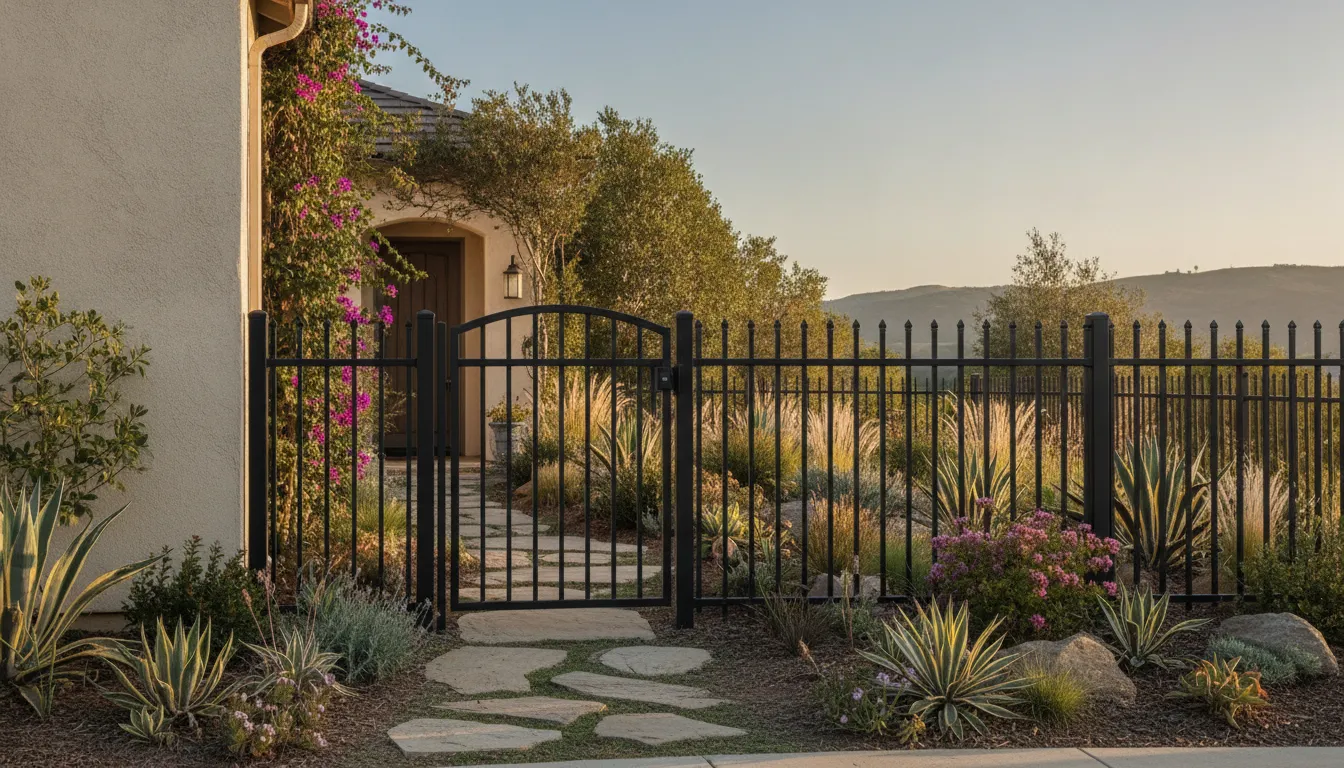
Balance appearance with everyday use
Start with how the gate will be used. A narrow pedestrian gate may serve a walkway, side yard, or pool-area approach, while a wider driveway gate must accommodate vehicles and allow enough clearance for its swing or operating system. Families may give extra attention to the latch location and how the gate behaves when someone is carrying groceries or supervising children. Pet owners may focus on openings, hardware, and whether the layout helps keep animals from reaching the street.
Appearance matters too. Flat-top, spear-top, decorative, and higher-security designs can create different impressions at the entry. Custom sizing and decorative options make it possible to coordinate the gate with an existing fence rather than treating it as an unrelated replacement. For more context on coordinating boundaries and styles, see these residential aluminum fence styles and consider which details should carry through to the gate.
Consider maintenance and coastal exposure
Aluminum is commonly selected for its resistance to rust and its relatively low-maintenance character. That does not mean every site condition can be ignored. Properties closer to the coast may expose metal components and finishes to salt-laden air, while irrigation, sprinklers, and landscaping can keep parts of the gate damp. Material selection, finish quality, drainage, and hardware choices should be discussed for the specific property. A coastal setting is a reason to plan carefully, not a reason to assume any aluminum product will perform identically in every location.
Match the gate to the property
The right decision also depends on the character of the home and the level of access control required. A manual gate may suit a simple side passage. A larger driveway entrance or a property with controlled access may need different posts, hinges, latches, or an automated system. Commercial owners and property managers may also weigh consistent appearance alongside traffic flow and security. A design-through-installation review can clarify those tradeoffs before the gate is ordered, especially when existing posts, slopes, or fence lines limit the available options.
How to choose an aluminum gate for your home
Start with how people will use the opening, not with the finish or decorative details. A narrow side entrance used by family members and pets has different requirements from a driveway opening that must accommodate vehicles, deliveries, and frequent daily traffic. Defining that use first makes the rest of the design easier to evaluate.
Match the gate to the type of access
For a pedestrian entrance, consider the clear walking width, the direction of travel, and how the gate will work with nearby steps, walls, landscaping, or a walkway. A self-closing or self-latching arrangement may be appropriate for some homes, especially where children or pets use the yard, but the hardware should be selected for the actual property and local requirements. For a driveway, think about vehicle turning space, the width needed for regular vehicles, and whether a single or double-entry configuration makes movement more practical.
Traffic also affects the gate system. An opening used occasionally may work well with a manual latch, while a busy driveway or controlled-entry property may benefit from planning for automation. Keypad, remote, smartphone, and intercom access are possible options for some automated systems. Decide who needs access and how visitors, service providers, and emergency access will be handled before choosing the hardware.
Check privacy, appearance, and measurements together
Aluminum gates can be selected in styles such as flat top, spear top, higher-security designs, or custom decorative configurations. Think about how much visibility you want from the street and whether the gate should repeat the lines of the existing fence. Coordinating the height, spacing, color, and post design usually produces a more intentional result than treating the gate as a separate feature. You can review residential aluminum fence styles for ideas that may help coordinate the surrounding boundary with the gate.
Before ordering, measure the opening and note the direction in which the gate can swing without striking a vehicle, structure, tree, or pathway. Record changes in grade, tight corners, and the location of existing posts. A slope may affect clearances and the most suitable hinge arrangement. Also consider exposure to coastal air, irrigation, and other local conditions when discussing finishes and hardware with an installer. The right aluminum gate is the one that fits the property’s movement, appearance, and access needs, rather than simply the one with the most decorative detail.
Which gate style and hardware fit your property?
The right aluminum gate starts with how people and vehicles will use the opening. A side entrance used by family members and pets has different needs from a driveway gate serving daily vehicle traffic. Before choosing a finish or decorative detail, consider the opening width, available swing clearance, who needs access, and whether the gate should remain manual or support controlled entry.
Compare aluminum gate configurations by use and planning needs:
- Pedestrian gate: A good fit for side yards, walkways, and garden access. Plan for comfortable walk-through width, latch placement, and alignment with the nearby fence. A manual latch may be sufficient, with controlled access added when appropriate.
- Driveway gate: A good fit for vehicle entrances and front approaches. Plan for vehicle clearance, swing path, posts, and slope at the opening. Choose manual operation or automation with keypad, remote, smartphone, or intercom access as needed.
- Double-entry gate: A good fit for wider driveways, equipment access, or flexible openings. The two leaves must align and have enough room to operate without conflict. Manual or automated operation can be selected based on traffic and access-control needs.
- Flat-top style: A good fit for clean, understated properties and coordinated fence lines. Plan for overall proportions, height, and how the top rail relates to adjoining panels. Pair it with a practical latch or other selected access hardware.
- Spear-top style: A good fit for decorative properties where a more ornamental profile is wanted. Plan for visual consistency with the fence and the desired balance between openness and presence. Use a manual latch or a controlled system selected for the opening.
- Higher-security configuration: A good fit for commercial areas, managed properties, or entrances needing more controlled access. Plan for gate scale, post strength, traffic patterns, and coordination with the access system. Security latch, keypad, remote, smartphone, or intercom options may be considered.
Match the hardware to the opening
Hardware should support the gate’s size, frequency of use, and exposure. Available options can include stainless-steel hardware, powder-coated hinges, security latches, and double-entry configurations. A pedestrian gate may only need a dependable latch and properly aligned hinges. A driveway or higher-security gate may require a more deliberate access-control plan so the operator, hinges, latch, and posts work together rather than being selected separately.
For a Southern California property, also account for the way the gate meets the existing fence, wall, driveway, or walkway. A custom-sized gate can help resolve an unusual opening, but the final design still needs to respect clearance and traffic conditions. If you are comparing installers, use these questions to ask a fence installer to confirm who will measure the opening, coordinate hardware, and explain manual versus automated access before work begins.
What should you plan before aluminum gate installation?
A successful gate installation begins with site decisions, not just a product choice. Before an installer prepares a proposal, walk through how the opening will be used, what surrounds it, and which conditions could affect the finished gate. This planning sequence is useful for homeowners and property managers, but it is not a substitute for a site-specific design review or local requirements.
- Measure the opening and identify its purpose. Record the approximate width, height, and available wall or fence connection points. Note whether the gate is for people, vehicles, or both. A pedestrian opening and a driveway opening have different traffic patterns, hardware needs, and clearance demands. Also identify whether a single or double-entry configuration makes sense for the way the property is used.
- Review the posts and footings. Ask how the gate posts will be sized, positioned, and supported for the selected gate and hardware. Existing posts may not be suitable for a new or heavier configuration. The installer should evaluate the soil, adjacent fence, and footing conditions rather than assuming that an existing opening can accept a replacement without modification.
- Map the swing and surrounding clearance. Decide which direction the gate should open and check the full arc of movement. Keep vehicles, walkways, landscaping, walls, steps, and equipment out of that path. If the site cannot provide a practical swing, ask whether a different configuration or access approach would better fit the property.
- Account for slopes and changes in grade. A driveway or walkway that rises, falls, or angles across the opening can affect the bottom clearance and gate alignment. Share measurements and photos of these transitions with the installer. The final design should be checked against the actual grade instead of relying on a level assumption.
- Locate utilities and other site obstacles. Mark visible irrigation, lighting, electrical, drainage, and low-voltage systems before excavation is planned. Ask who will verify underground utilities and how unexpected obstructions will be handled. This is especially important when posts, automation equipment, or access-control wiring are part of the project.
- Check HOA and property requirements. If an HOA, property manager, or commercial site controls exterior changes, confirm whether drawings, finish selections, gate height, or access equipment require review. Do not assume that a rule applying in one Orange County community applies in another. Pool-related gates and powered access may also require separate local verification.
- Prepare questions for the installer. Ask about the proposed aluminum grade, post and footing approach, hinge and latch selection, opening direction, drainage and slope, manual versus automated access, maintenance expectations, and how the gate will coordinate with the existing fence. This checklist of questions to ask a fence installer can help organize the conversation.
Bring the intended use, measurements, photos, and any HOA information to the design consultation. A professional installer can then confirm what is feasible at the property and separate straightforward choices from conditions that need a more careful solution.
How much does an aluminum gate cost?
The cost of an aluminum gate depends on the project rather than one standard price. A useful estimate accounts for the gate’s size, intended use, design, hardware, access system, site conditions, and installation requirements. Asking for those details upfront helps you compare complete proposals instead of comparing a gate panel price with a finished installation.
What affects the estimate?
Dimensions are one of the first variables. A narrow pedestrian gate has different material and support requirements from a wider driveway opening. A single gate may be appropriate for everyday foot traffic, while a double-entry configuration may be better when vehicles, trailers, or larger equipment need to pass through. Custom sizing can also affect fabrication and fitting when the opening does not match a standard layout.
Style and finish influence the scope as well. Flat-top, spear-top, decorative, and higher-security designs each involve different components and visual details. The estimate should identify the selected design and finish. Avoid vague descriptions such as “metal gate.” It should also explain whether the gate is being coordinated with an existing fence or installed as part of a new system.
Hardware is another meaningful cost driver. Stainless-steel hardware, powder-coated hinges, security latches, and other components may be appropriate depending on the gate’s weight, use, and security goals. Automation adds additional planning for the operator, power, controls, and safety equipment. Access options may include a keypad, remote, smartphone, or intercom system. Select the level of control you actually need, since a simple side entrance and a controlled driveway entry serve different purposes.
Why site conditions matter
Installation complexity can change the estimate even when two gates appear similar. The installer may need to account for existing posts, footing conditions, slope, paving, drainage, clearance for the swing, and the path for utilities or access-control wiring. Removal of an old gate or adjustments to an existing fence can add work as well. Coastal exposure and the property’s environment may also affect material and finish recommendations, so the site should be reviewed rather than assumed from a photo alone.
Before approving a proposal, ask for the gate dimensions, style, posts and hardware, manual or automated operation, access-control components, site preparation, installation scope, and any exclusions. A project-specific review is the most reliable way to understand what your aluminum gate will require.
How do you maintain an aluminum gate in coastal California?
An aluminum gate is generally straightforward to care for, but coastal conditions make routine observation worthwhile. Salt carried in sea air, dust, irrigation overspray, and ordinary outdoor grime can collect on the frame, hinges, latch, and posts. Gentle cleaning helps you see the hardware and finish clearly without introducing unnecessary wear.
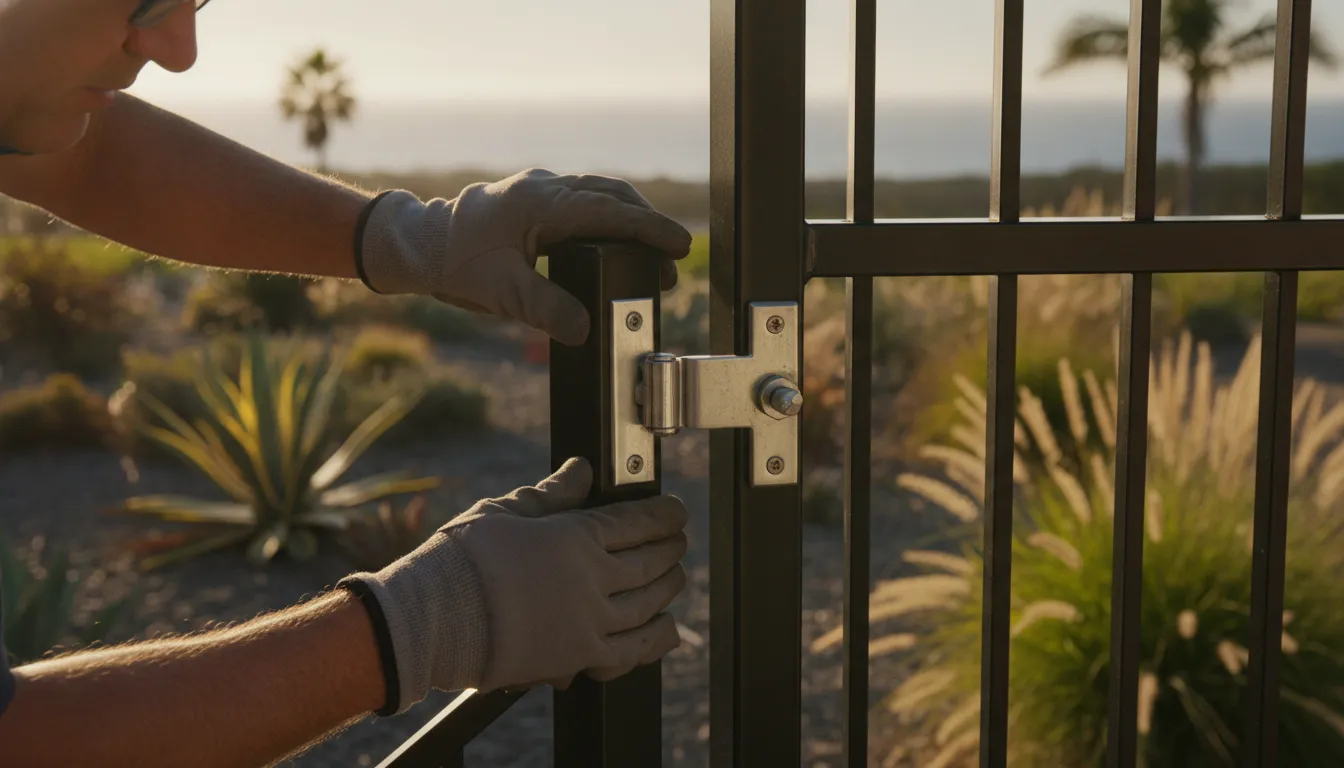
Clean the frame and hardware gently
Start with water and a soft cloth or soft-bristle brush. If the surface needs more cleaning, use a mild soap solution and rinse thoroughly so residue does not remain on the finish. Avoid abrasive pads, harsh solvents, and aggressive pressure washing directed at hinges, latches, or access-control components. Do not assume that a cleaner suitable for another fence material is appropriate for a powder-coated aluminum finish. When in doubt, follow the finish or hardware manufacturer’s care instructions.
Watch for changes in movement
When you use the gate, pay attention to how it opens, closes, and latches. A gate that begins to drag, bind, sag, swing differently, or stop lining up with its latch deserves attention. Look at the hinges, latch, posts, fasteners, and the ground around the opening for visible movement or damage. For an automated gate, also observe unusual noise, hesitation, or inconsistent response, and follow the equipment manufacturer’s service guidance rather than attempting an electrical repair yourself.
Coastal exposure does not create a reason to promise a fixed service life or a rust guarantee. It does make it useful to keep the gate clean and to address small changes before they affect alignment or safe operation. Avoid forcing a stuck gate or repeatedly adjusting hardware without understanding the cause. Movement in a post, footing, hinge, latch, or surrounding grade can require different repairs.
When should an installer inspect the gate?
Ask a qualified installer to inspect the gate if it no longer closes reliably. An inspection is also warranted if the latch misses, the posts appear out of plumb, the frame shifts, or the opening changes after landscaping, construction, or ground movement. An installer can evaluate alignment, hardware condition, clearance, and the relationship between the gate and adjacent fence. That is especially important for a driveway gate, a gate used by children or pets, or an entry connected to an automated access system.
What changes when an aluminum gate serves a pool or controlled entry?
A gate beside a pool or at a controlled-entry property has a different job from a decorative side gate. The design must account for who is expected to use it, who should not pass through it, and what happens when the gate is released, closed, or left unattended. Families may need dependable protection for children and pets, while a commercial property or managed community may need a clear process for residents, guests, deliveries, and staff.
For a residential pool enclosure covered by California Health and Safety Code section 115923, the cited provision addresses several features. These include a minimum 60-inch enclosure height, limited bottom clearance, restricted openings, and an exterior surface without climbable footholds or handholds. It also states that access gates open away from the pool and are self-closing with a self-latching device placed no lower than 60 inches above the ground. Read the full California pool-enclosure provision before planning the work. This is a pool-specific reference, not a universal rule for every gate or property in California. Local building officials, project conditions, permit requirements, and HOA rules should be verified before installation.
Plan the gate around the people and animals using the property
Self-closing and self-latching hardware can help reduce the chance that a gate remains open after someone passes through. The hardware must be selected, positioned, and adjusted for the actual opening. Ask how the latch will be reached by adults while remaining out of the normal reach of young children. Check that the swing does not strike a wall, furniture, landscaping, or pool equipment, and consider whether a dog could push under, through, or around the gate. Clearance and gaps deserve the same attention as the gate frame, especially where small children or pets are present.
Separate pool safety from controlled access
A controlled-entry aluminum gate may use a security latch, keypad, remote, smartphone control, or intercom. Those choices can make sense for a driveway, apartment community, business, or facility, but access control does not replace a required pool barrier. Commercial users should also discuss traffic flow, emergency access, visitor credentials, delivery timing, and who is responsible for testing the closing and latching action. A manual pedestrian gate may be appropriate for one opening, while a wider or automated configuration may better fit another.
For additional context on the barrier and surrounding layout, see these black aluminum pool fence options. Keep the project gate-focused: confirm measurements, swing direction, hardware, clearances, and local requirements with an experienced installer before committing to a design.
Request a free project estimate | Discuss your aluminum gate options
Frequently Asked Questions About Aluminum Gates
How much does an aluminum gate cost?
There is no single useful price because the project scope changes the estimate. Size, customization, hardware, automation, site conditions, and installation complexity all affect the total. Ask for a project-specific estimate that identifies the gate type, measurements, access system, site work, and installation included.
Is an aluminum gate better than steel?
It depends on the property and the job the gate must perform. Aluminum offers a lightweight, rust-resistant option with an ornamental appearance. Steel may be considered when a project has different structural or security priorities. Compare the materials with the intended opening size, exposure, hardware, and security needs rather than choosing by material name alone.
Can I install an aluminum gate myself?
A simple replacement may appear manageable, but a new gate requires accurate measurements, properly positioned posts and footings, clearance for the swing, and hardware that keeps the gate aligned. Slopes, driveway traffic, automation, and local requirements can add complexity. Professional site planning helps reduce fit and operation problems.
Can an aluminum side gate be customized?
Yes. Available options can include custom sizing, decorative details, flat-top or spear-top styling, finish selection, security latches, and single or double-entry configurations. Coordinate the gate with the adjacent fence, the available clearance, and how people, pets, vehicles, or service providers will use the opening.
What should I confirm for an aluminum pool gate?
Pool gates require a code-specific review, not just a material choice. For covered residential pool enclosures, California Health and Safety Code section 115923 addresses features including a 60-inch minimum height, limited gaps, an outward-opening gate, and self-closing, self-latching hardware. Verify the current requirements with the applicable local building department before installation: California HSC section 115923.
Ready to plan your aluminum gate?
A site-specific conversation can help you compare styles, access needs, and installation details before choosing a direction. To request a project estimate or discuss aluminum gate options with A G Vinyl Fencing, contact us through the project estimate form.

Gary Andreasyan is at the forefront of A G Vinyl Fencing, setting the standard for high-quality fencing solutions. His expertise in vinyl fencing has positioned the company as a go-to for durable, low-maintenance fencing options that enhance property value and security. Gary’s commitment to customer satisfaction and innovative fencing solutions drives A G Vinyl Fencing’s success, providing clients with a range of styles and designs that meet their specific needs and preferences.


0 Comments